

Chapter 1
The neural construction zone
Chapter 2
Tuning your ears to the world
Chapter 3
The science of micro-habits
Chapter 4
The bilingual superpower
Ch 2 · Tuning your ears to the world
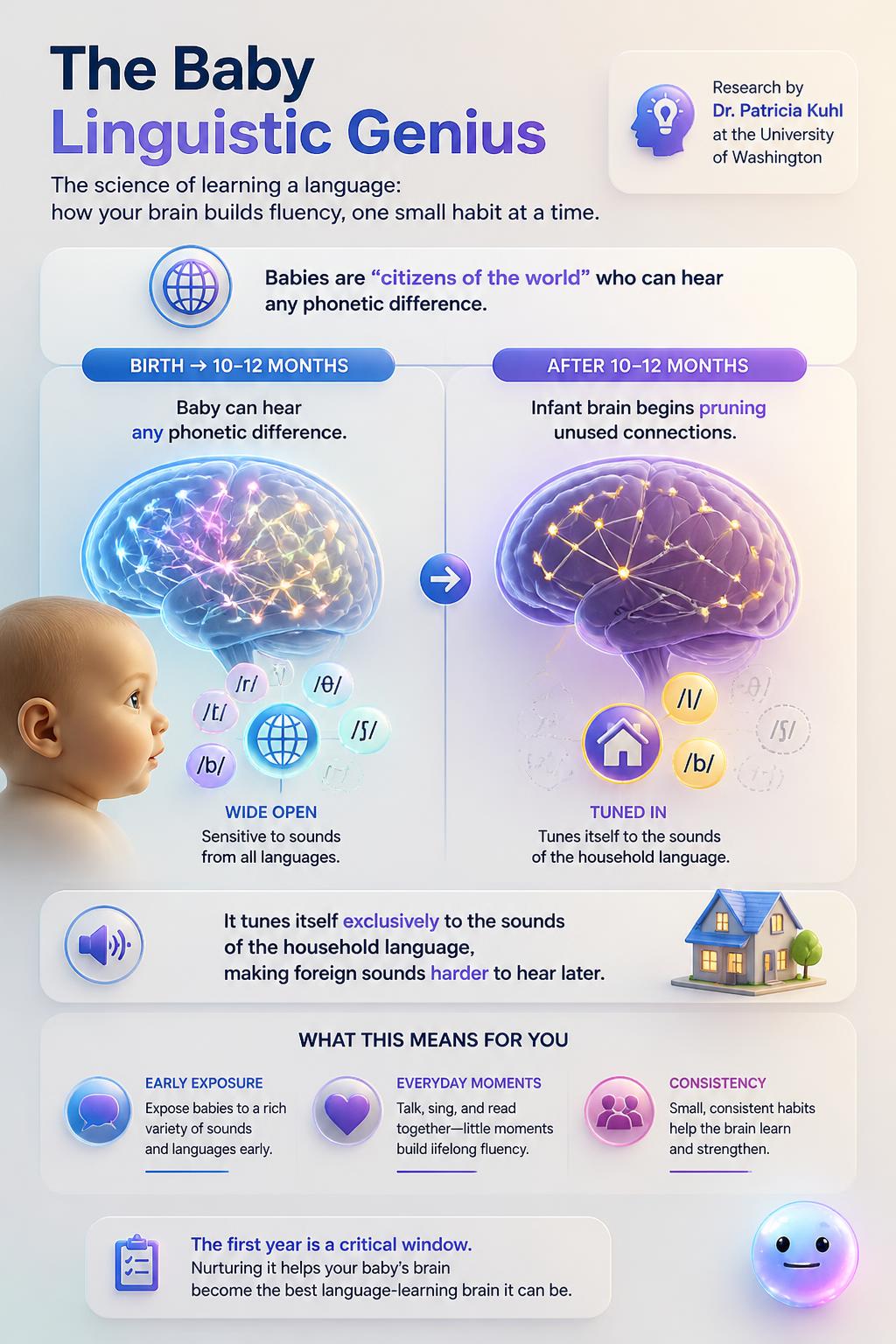
duolingo University of Washington research explains how infant brains prune connections by ten to twelve months to prioritize household language sounds.
Quiz
Roughly how many unique speech sounds, or phonemes, are babies capable of distinguishing at birth?
Quiz
According to research by Dr. Patricia Kuhl, at what age does an infant's brain begin to lose the ability to distinguish foreign speech sounds?

duolingo Achieving true native-like fluency requires starting a new language by age 10.
Quiz
The 2018 MIT study on language acquisition discovered that the prime window for learning grammar remains highly active until what age?
Quiz
According to the 2018 MIT study, by what age must a child start learning a language to achieve native-like mastery of its grammar?
Fun Fact
Sound tuning: Babies raised in bilingual homes can distinguish the differences between two languages by just seven months of age.
Quiz
Why does learning a tonal language like Mandarin Chinese require speakers to use both hemispheres of the brain instead of just the left?
Quiz
Which African language family is famous for using distinct click consonants that challenge the auditory processing of non-native speakers?
Glossary
frequency (noun)
The rate at which a vibration occurs that constitutes a wave, such as in sound. Spanish speakers natively process frequencies up to 2,500 hertz, while Russian speakers process up to 11,000.
The rate at which a vibration occurs that constitutes a wave, such as in sound. Spanish speakers natively process frequencies up to 2,500 hertz, while Russian speakers process up to 11,000.
Quiz
Which sensory brain region is responsible for mapping and sorting the spoken sounds we hear into recognizable phonemes?
Quiz
Why do adult language learners often struggle to pronounce foreign sounds with a perfect native accent?