
Energy efficiency: The human brain runs on just 20 watts of
Energy efficiency: The human brain runs on just 20 watts of power, while a supercomputer simulating it would require megawatts of electricity.
The fly that mapped the future
The exabyte hurdle of the human brain
Project Humane and the digital twin
Learning and growing in a virtual world
The copy paradox and neuroethics
hazeker999 Scientists map the tiny fruit fly's 139,255 neurons. This milestone highlights how our 86 billion neurons and 100 trillion synaptic connections make us 600,000 times more complex.
hazeker999 Electron microscopes take thousands of years to scan a human brain. Argonne National Laboratory scientists test synchrotron X-ray technology to map large tissues safely and much faster.
hazeker999 A dim lightbulb matches the twenty watts powering a human brain. The Frontier supercomputer in Tennessee demands megawatts and millions of dollars to simulate that same activity.

hazeker999 Scan neural pathways to discover how digital brain copies form their own memories.
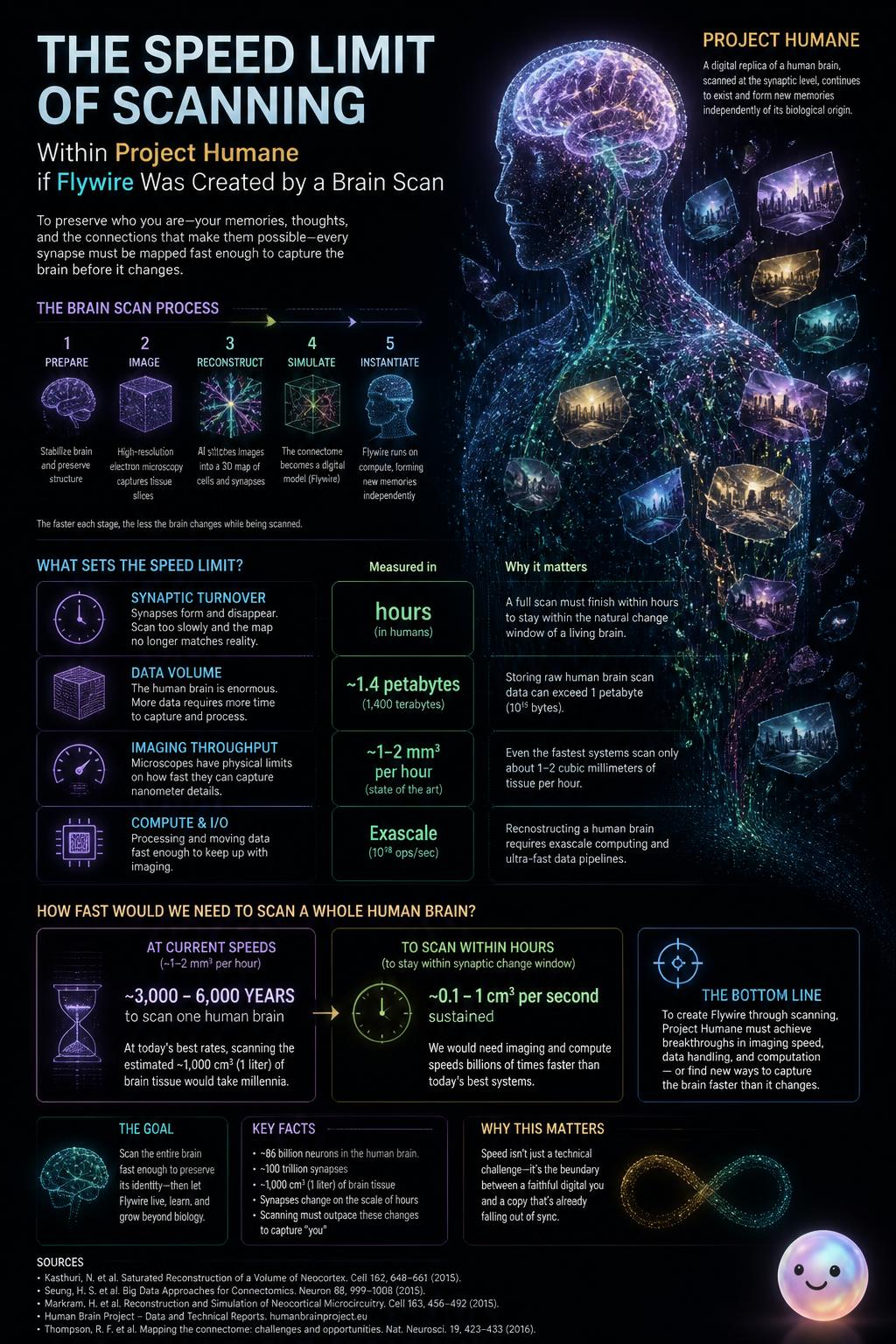
hazeker999 Current scanning techniques are far too slow to map a human brain in a lifetime.
Energy efficiency: The human brain runs on just 20 watts of power, while a supercomputer simulating it would require megawatts of electricity.

hazeker999 Storing a complete high-resolution map of a human brain would require unprecedented digital storage.
A unit of digital information storage equal to one quintillion bytes. In 2024, researchers estimated that mapping a complete human connectome would require hundreds of exabytes of storage.
What type of non-destructive high-speed scanning technology is being tested for larger brains?
Why can't we easily use standard electron microscopy to scan a whole human brain today?
How much digital data is estimated to store a complete high-resolution human connectome?
How many synapses, or neural connections, are estimated to be in the human brain?