
What surprising material did H.R. Giger use to create the stretching
What surprising material did H.R. Giger use to create the stretching jaw tendons of the adult Xenomorph?
The birth of biomechanical art
The creation of a cinematic nightmare
Beyond the movie screen
Walking inside the nightmare

schopenhauer The biomechanical art book by H.R. Giger that transformed science fiction.
schopenhauer Artist H.R. Giger created organic special effects for the movie Alien.
schopenhauer HR Giger's Xenomorph Suit
Real snake bones, a human skull, and shredded latex jaws!

schopenhauer Match Giger's surreal artworks to discover how his biomechanical style shaped modern sci-fi films.
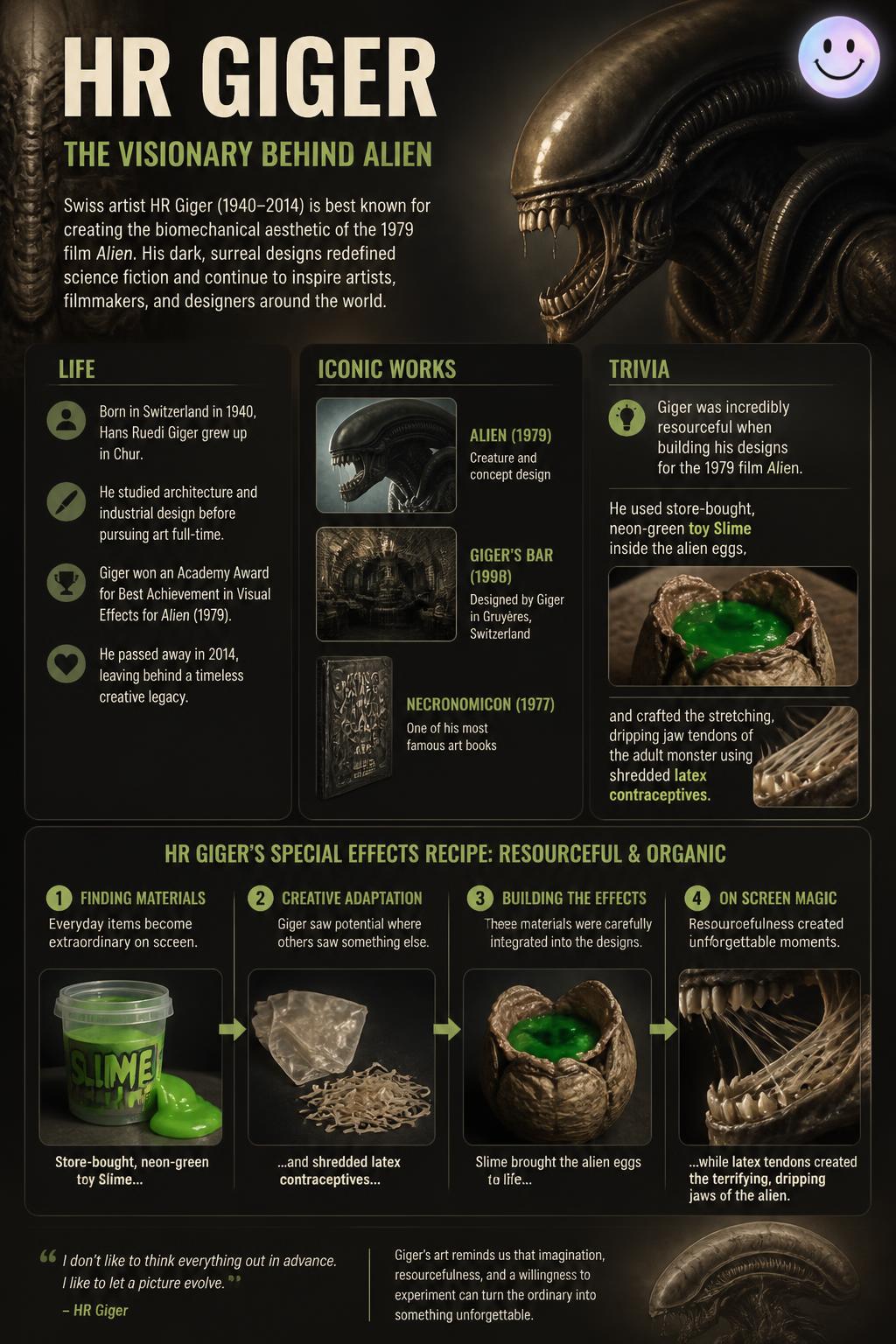
schopenhauer To bring the Xenomorph to life, Giger used bizarre everyday items like toy green slime and latex contraceptives.
Xenomorph's eyes: H.R. Giger deliberately designed the Xenomorph in Alien without eyes because he believed a creature that you cannot see looking at you is far more terrifying.

schopenhauer Giger personally sculpted the iconic adult Xenomorph, blending human bones with plasticine to create a physical monster.
A strange form or an extraterrestrial creature. H.R. Giger designed the biomechanical beast for Ridley Scott’s 1979 film Alien.
Which of H.R. Giger's art books caught the attention of director Ridley Scott for the movie Alien?
Where did H.R. Giger travel to personally hand-sculpt the sets and creatures for the 1979 film Alien?
Which specific H.R. Giger painting served as the direct inspiration for the adult Xenomorph?
What surprising material did H.R. Giger use to create the stretching jaw tendons of the adult Xenomorph?
In which year did H.R. Giger win an Academy Award for his visual effects work on Alien?
What did H.R. Giger use to construct the primary texture of the Xenomorph's elongated skull?
What popular 1970s children's toy did H.R. Giger use inside the Xenomorph eggs?