Chapter 1
The early years and Italian landscapes
Chapter 2
The magic of tessellations and repeating patterns
Chapter 3
Impossible dimensions and optical illusions
Chapter 4
The global legacy and pop culture impact
YOUR GOAL
Master of The impossible art of Escher
Ch 2 · The magic of tessellations and repeating patterns
schopenhauer Tessellations and Repeating Patterns
Those old Alhambra tiles became a magic key To blend the birds and fish in endless symmetry
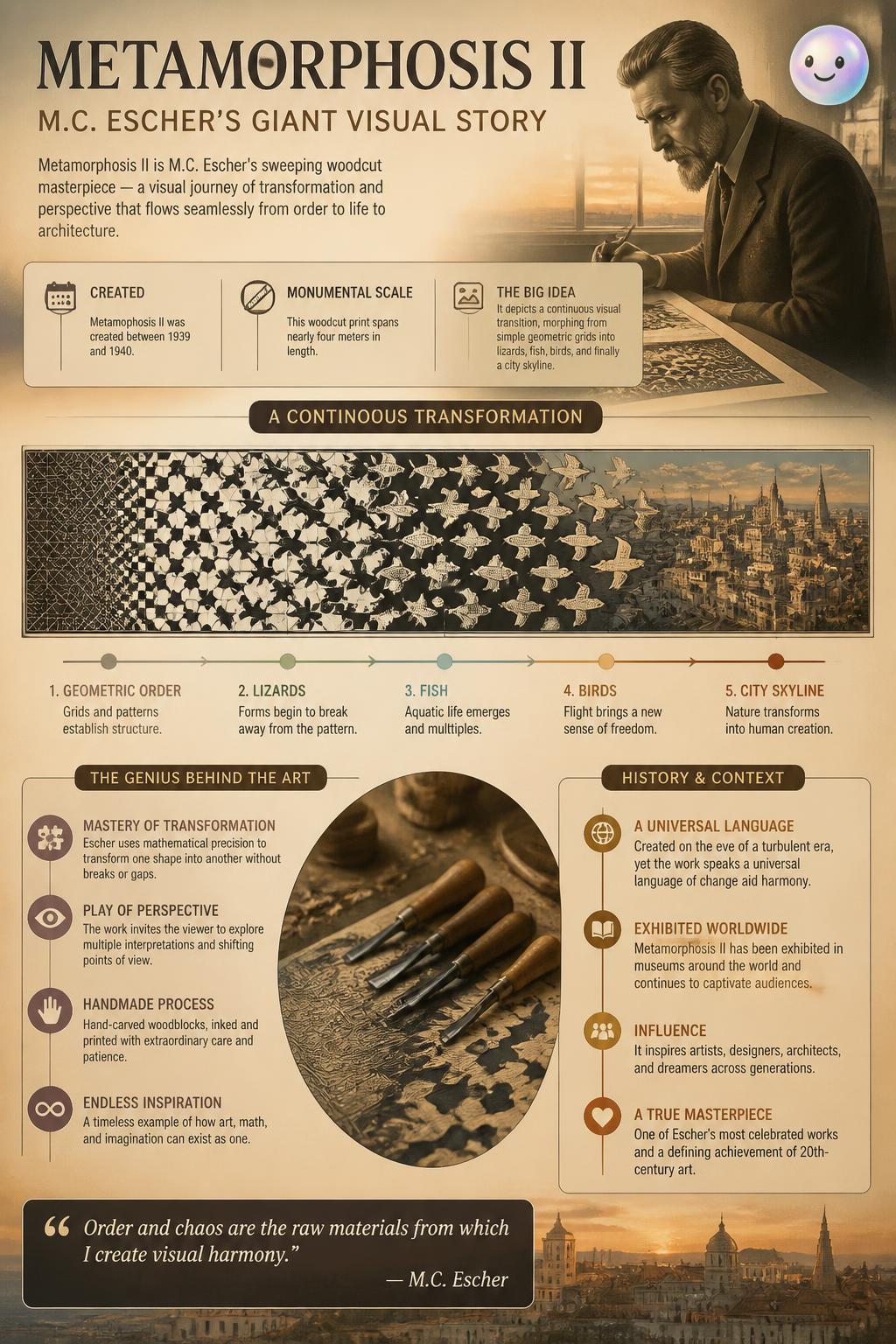
schopenhauer Escher combined his love of patterns with storytelling, creating massive prints where one shape gradually morphs into another.
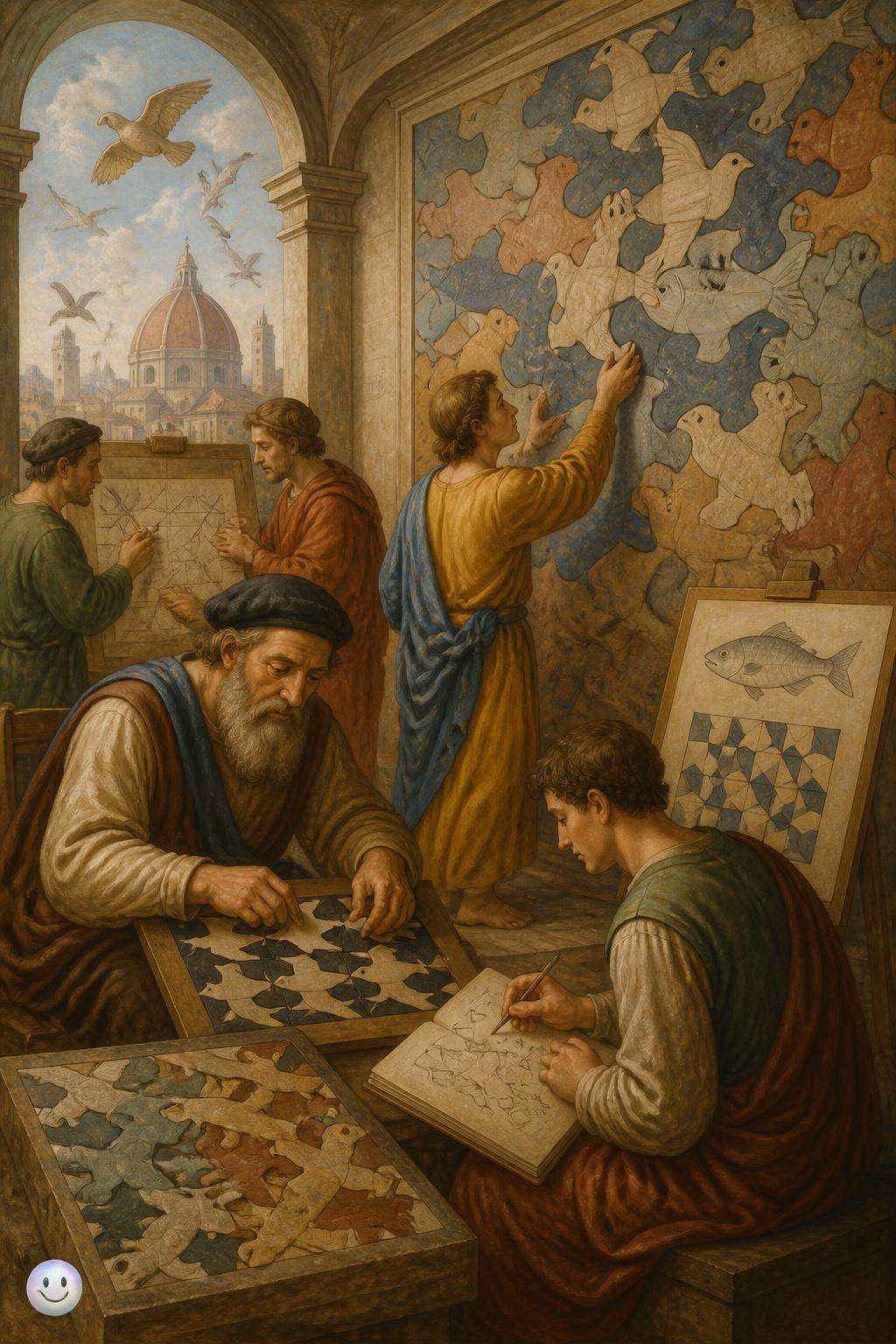
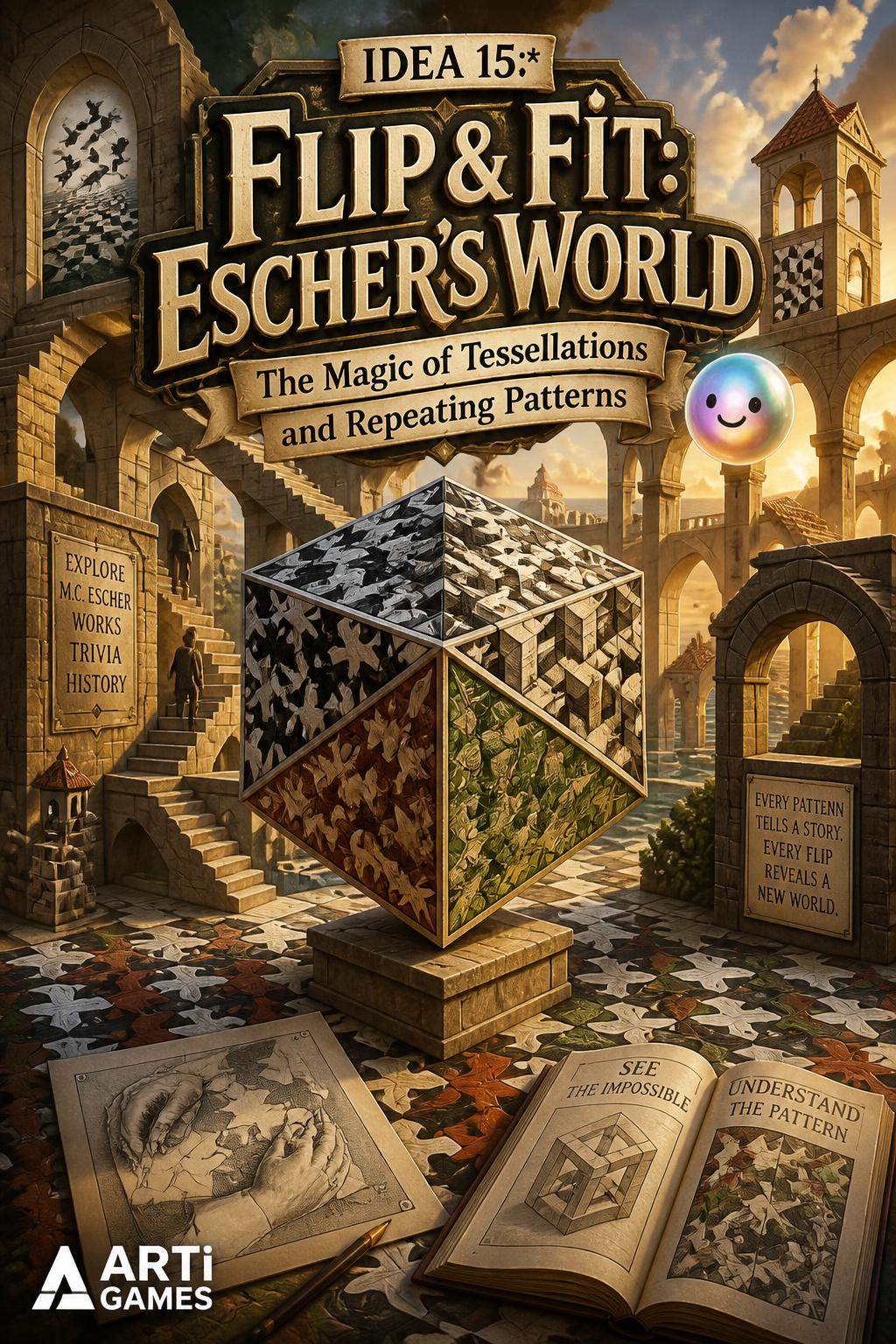
schopenhauer Escher became obsessed with tessellation, the art of covering a flat surface with interlocking shapes that leave absolutely no gaps.
BETA
schopenhauer Flip and fit interlocking tiles to discover how Escher blended math and art.
Fun Fact
Alhambra tile rules: Moorish artists used only geometric patterns due to religious rules, but Escher broke this by interlocking recognizable animals.
Glossary
tessellation (noun)
An arrangement of shapes closely fitted together, especially of polygons in a repeated pattern without gaps or overlaps. M.C. Escher was inspired to create these designs after visiting Spain's Alhambra palace in 1922.
An arrangement of shapes closely fitted together, especially of polygons in a repeated pattern without gaps or overlaps. M.C. Escher was inspired to create these designs after visiting Spain's Alhambra palace in 1922.
Quiz
What is the name of the 1964 woodcut that uses repeating patterns to shrink shapes infinitely toward the edge?
Quiz
What kind of printmaking technique did M.C. Escher use to make 'Metamorphosis II'?
Quiz
What is the mathematical term for covering a flat surface with repeating shapes with no gaps or overlaps?
Quiz
Why did the Moorish artists at the Alhambra use only abstract geometric shapes in their tiles?
Quiz
Which historic Spanish palace inspired M.C. Escher's obsession with interlocking geometric tiles?
Quiz
Which mathematician's academic paper on plane symmetry did M.C. Escher study to master his pattern layouts?
Quiz
In M.C. Escher's famous print 'Reptiles' (1943), what do the little lizards do?