
* Whose Red Is It? * Mind Glasses *
The puzzle of perception
The mystery of qualia
The hard problem
Global perspectives on the self
Tech and the future of minds
gertrude Sensory pathways take eighty milliseconds to align sight and sound. This processing lag allows the neural network to stitch together a smooth, coherent narrative of reality.
gertrude Locked inside a dark skull, the brain translates electrical signals to constantly predict and build our sensory world. Seth describes this process as a controlled hallucination.

gertrude In 1781, German philosopher Immanuel Kant published the Critique of Pure Reason. He revealed how our brains actively shape our sensory experiences instead of just recording raw reality.
gertrude In 1909, German biologist Jakob von Uexküll revealed that animals live in unique sensory bubbles called Umwelt. A tick senses only heat, while dogs navigate by smell.

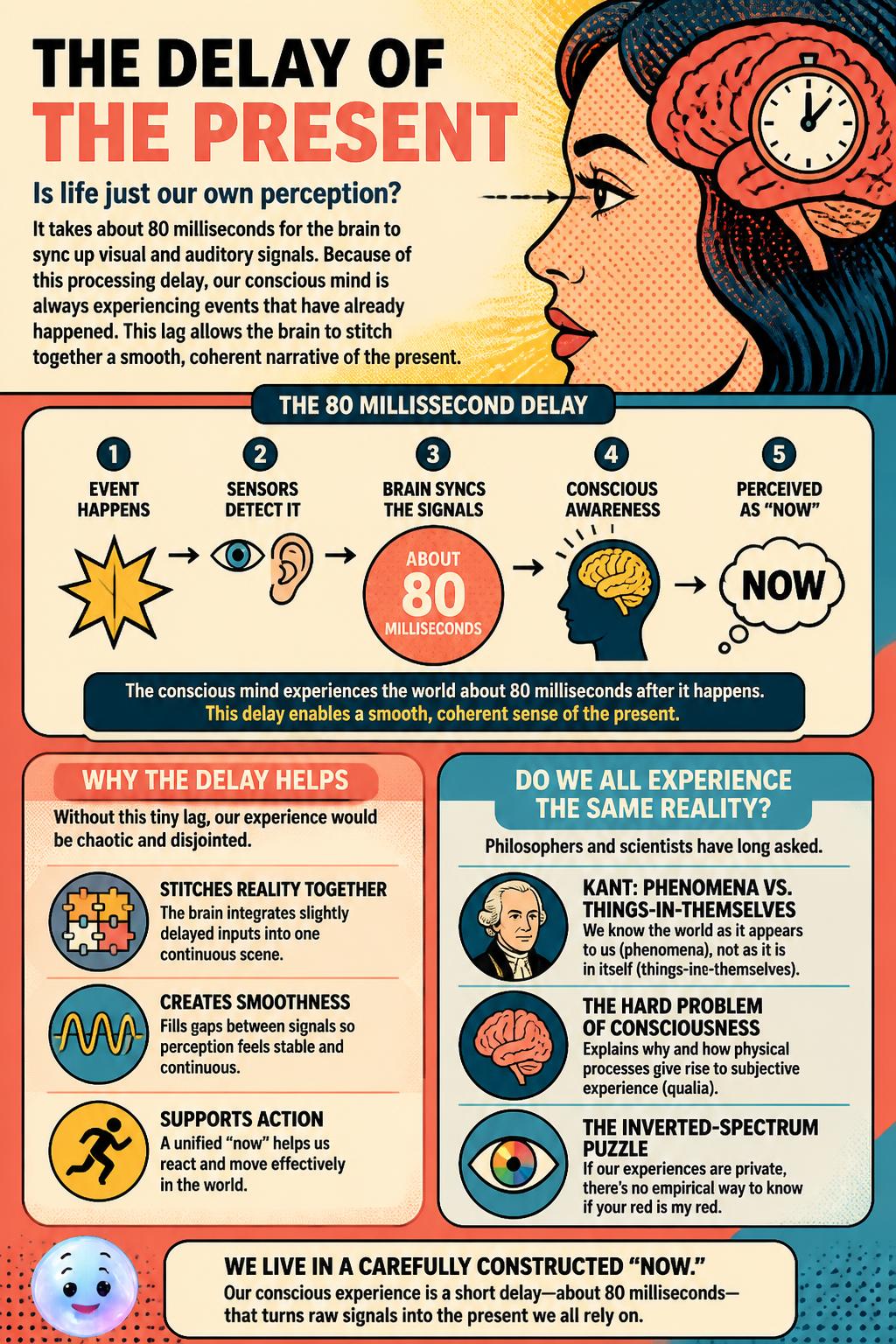
gertrude Because sensory signals take time to travel and process, we always live slightly in the past.
Mantis shrimp vision: They have 16 color receptive cones compared to our three, letting them see types of light completely invisible to humans.

gertrude Modern neuroscience shows that the brain constructs a best-guess model of reality based on limited sensory signals.
The internal, subjective components of sensory experiences, such as the redness of a rose. In 1690, John Locke proposed the inverted-spectrum thought experiment to explore these subjective sensory differences.
What term did Immanuel Kant use to refer to the external world of "things-in-themselves," which we can never directly perceive?
What do cognitive scientists call the theory that the brain does not passively record reality, but instead actively predicts it?
Approximately how many milliseconds of delay does the human brain experience when processing sensory information to create a conscious moment?
Which German philosopher in 1781 wrote "Critique of Pure Reason" to distinguish between things-as-they-appear and things-in-themselves?
Which organ is entirely locked in a dark, silent chamber while constructing your entire visual and auditory reality?
Which German biologist introduced the term "Umwelt" in 1909 to describe the unique sensory world of different animal species?