
Your brain registers 'I love you' with clinical distance in a second language.
The physical remodel of your gray matter
The bilingual cognitive shield
The mental shift of multilingual minds
The lifelong journey of the neural landscape

duolingo Researchers use skin conductance tests to show how our sweat glands and amygdala ignore the emotional weight of foreign words. We process second-language insults and affection with clinical distance.
duolingo During a 2006 study, bilingual Mexican-Americans took personality tests in both languages. They scored higher on extraversion and conscientiousness in English because cultural norms trigger distinct brain patterns
duolingo Cognitive scientist Lera Boroditsky demonstrates how German and Spanish speakers describe the sun and moon. Different grammatical genders prompt people to use highly masculine or feminine adjectives.
duolingo Researchers at the University of Chicago in 2012 proved that foreign tongues eliminate the framing effect. A brief cognitive delay dampens emotional reactions and boosts analytical logic.

duolingo Flip the cards to discover how learning a new language rewires your brain.
duolingo Multilingual Minds
Growing denser grey matter in the left parietal lobe as we speak
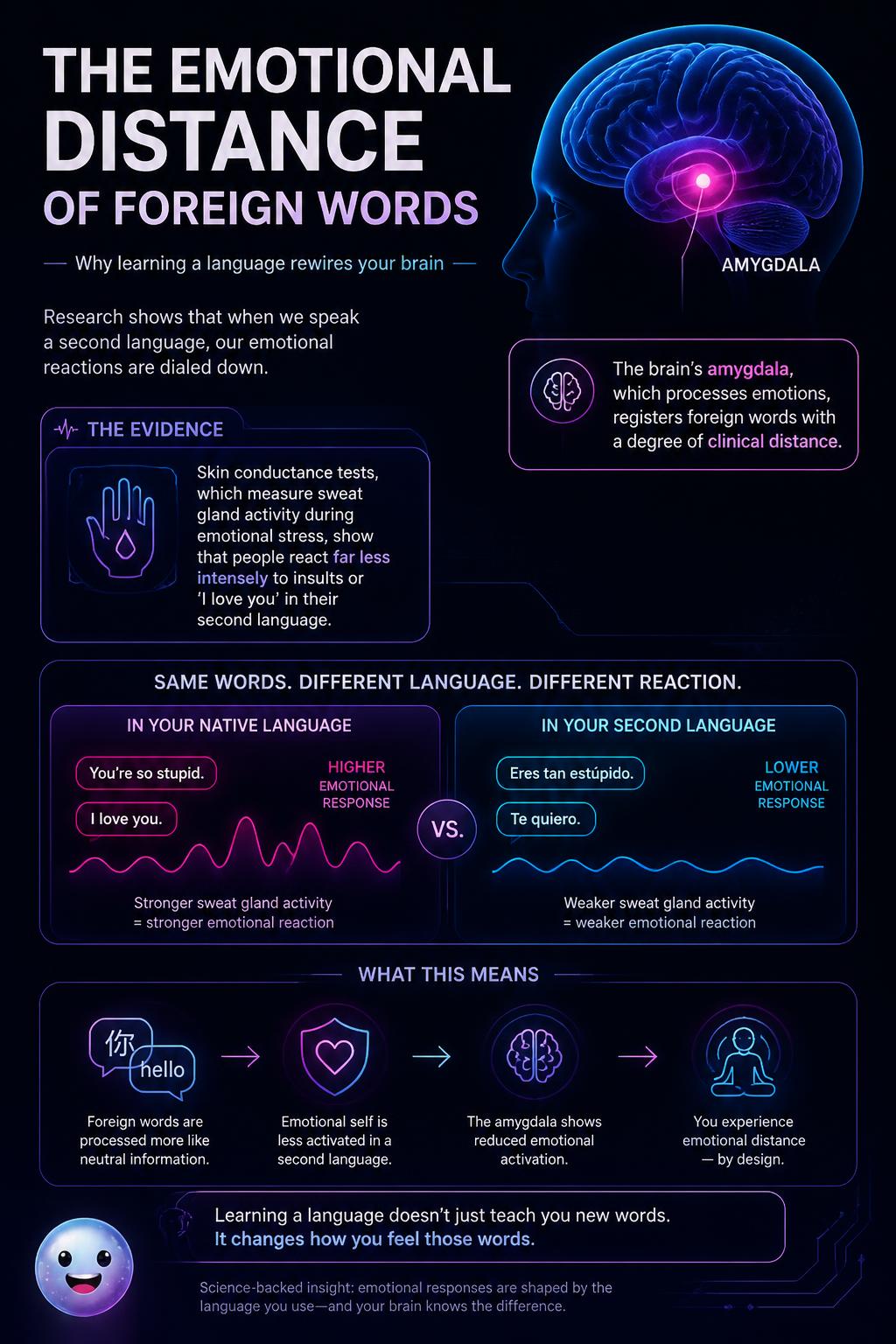
duolingo A diagram compares sweat gland activity when hearing emotional words in different languages.
Logical distance: When making high-stakes financial decisions, people who think in their second language are statistically less likely to make emotional, loss-averse mistakes.

duolingo An isometric glass brain render with precise labels showing personality shifts between languages.
In the 2006 study of Mexican-Americans, how did language affect their personality test scores?
What did a 2012 University of Chicago study discover about decisions made in a second language?
Which brain structure, responsible for processing emotions, reacts less intensely to insults in a second language?
Which cognitive scientist studied how grammatical genders in German and Spanish affect how speakers describe everyday objects?
If a language assigns a masculine gender to 'key', how are its speakers statistically more likely to describe a key?