
How does bad faith differ from a lie for Sartre?
Do you know how Jean-Paul Sartre distinguishes bad faith from a standard lie? Test your understanding of existentialist philosophy with this quick quiz.
The weight of absolute freedom
Playing roles and bad faith
Authenticity in the digital age
sloane While ordinary liars deceive others, bad faith means we actively choose to believe our own lies.
sloane Sartre described a woman on a date pretending her hand is just an object to avoid choosing.
sloane Sartre warned that letting a job define you is bad faith, because you are always more.

sloane Sort curated social profiles to discover how playing a role limits your freedom.
sloane Sartrean bad faith
Like Sartre's waiter with his café tray (with his tray!) / We play a role to hide we're free today (we are free!)
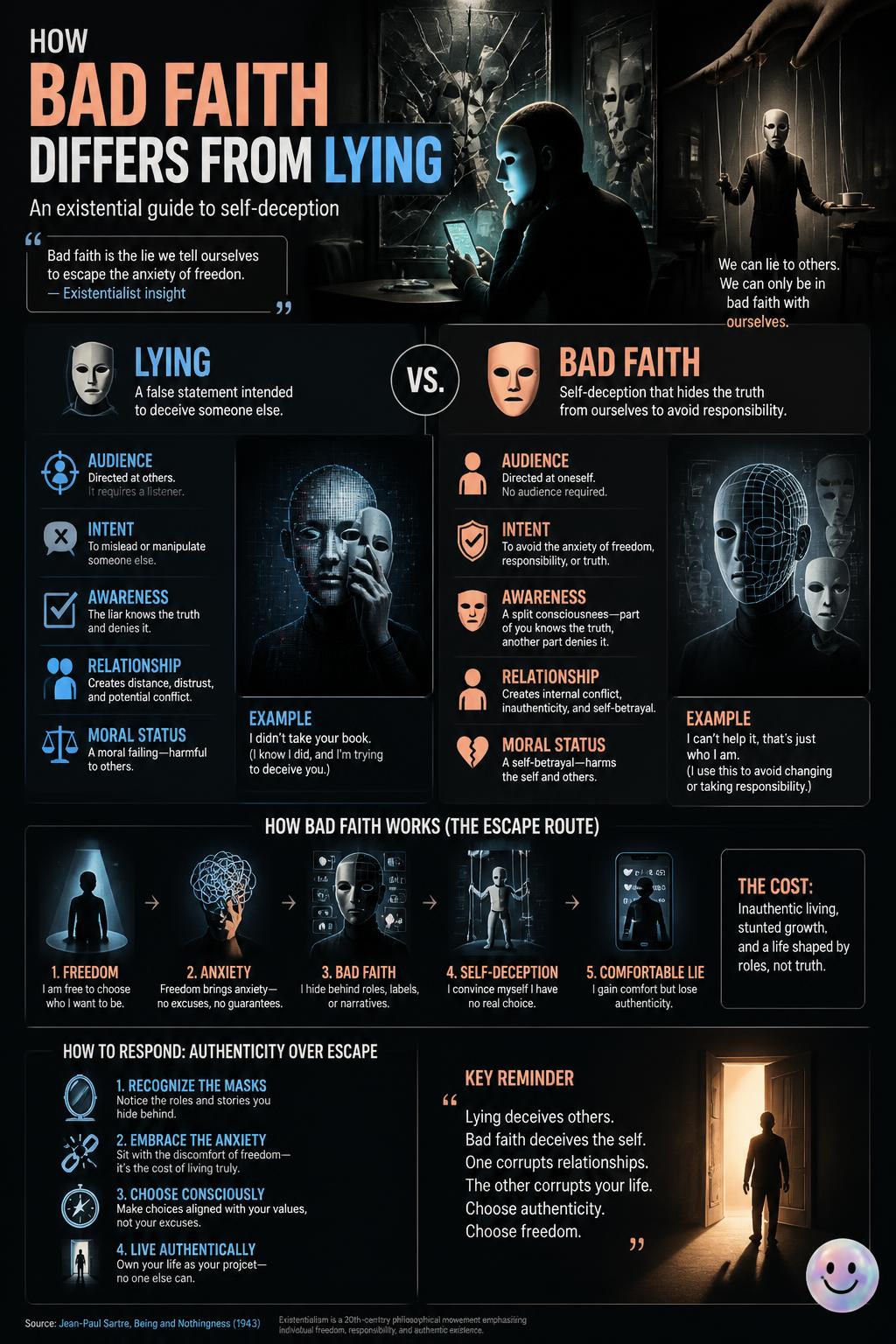
sloane Bad faith is a unique psychological state where we deceive ourselves, not others.
Sartre's eye condition: Sartre had exotropia, a condition making his eyes look in different directions, which he joked helped him see multiple perspectives at once.

sloane A classic existentialist example shows how we pretend not to notice our choices.
Intentional dishonesty or a refusal to deal fairly with others. In 1943, Jean-Paul Sartre illustrated this behavior using a Parisian waiter who exaggerated his movements.
In 'Being and Nothingness', which profession did Jean-Paul Sartre use as a prime example of someone playing a role?
Which of the following is an example of bad faith according to Jean-Paul Sartre's philosophy?
According to existentialist philosophy, what is the ultimate goal of overcoming bad faith?
What did Jean-Paul Sartre believe we are doing when we say 'I am just a doctor' or 'I am just a student'?