Chapter 1
The invisible hand of game psychology
Chapter 2
Secrets of the virtual architect
Chapter 3
The math of fun and balance
Chapter 4
The evolution of touch and play
Chapter 5
The symphony of interactive sound
Ch 1 · The invisible hand of game psychology


BETA
sonia Place subtle rewards to discover how game designers nudge players toward their goals.
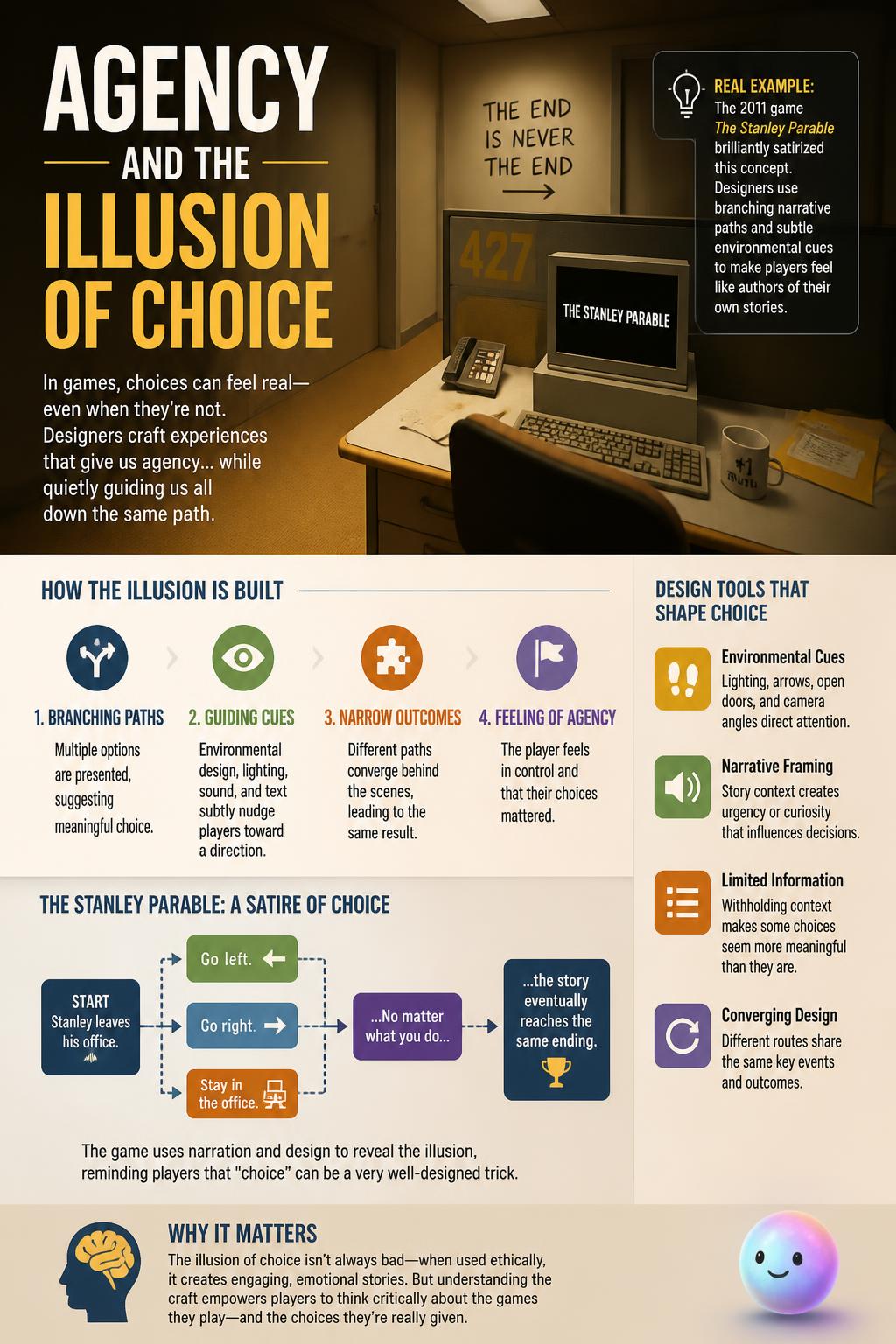
sonia Giving players choices makes them feel in control, even when the path is carefully guided.
Fun Fact
Flow state: Tetris was designed in 1984 by Alexey Pajitnov specifically to trigger a relaxing, highly focused state of cognitive order.

sonia Every button press must feel satisfying through immediate visual, auditory, and tactile reactions.
Glossary
indirect control (noun)
The guidance of a subject's behavior or choices through subtle environmental cues rather than explicit commands. Jesse Schell outlined this concept in 2008, showing how behavioral cues guide players without restricting their freedom.
The guidance of a subject's behavior or choices through subtle environmental cues rather than explicit commands. Jesse Schell outlined this concept in 2008, showing how behavioral cues guide players without restricting their freedom.
Quiz
Who coined the psychological term "flow" that game designers use to balance challenge and skill?
Quiz
What term do game designers use to describe satisfying sensory feedback like sparks, sounds, and screen shakes?
Quiz
Which 1930s psychologist's behavior experiments inspired the reward schedules used in modern video games?