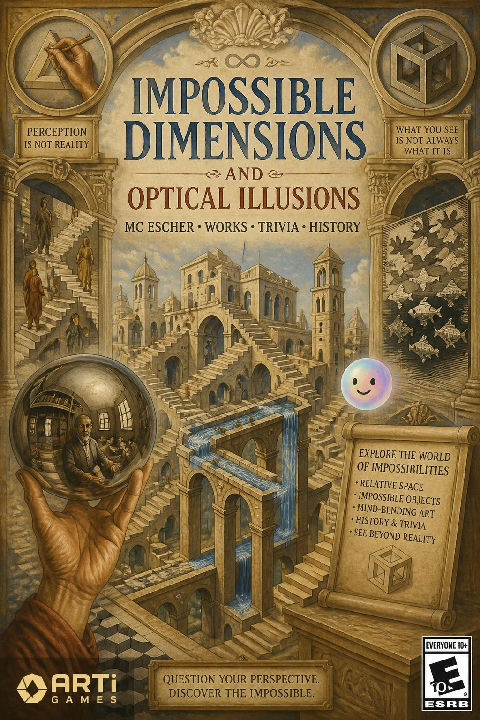
Chapter 1
The early years and Italian landscapes
Chapter 2
The magic of tessellations and repeating patterns
Chapter 3
Impossible dimensions and optical illusions
Chapter 4
The global legacy and pop culture impact
YOUR GOAL
Master of The impossible art of Escher
Ch 3 · Impossible dimensions and optical illusions
schopenhauer Impossible Dimensions
Up the stairs, up the stairs / Walking in a loop to nowhere.
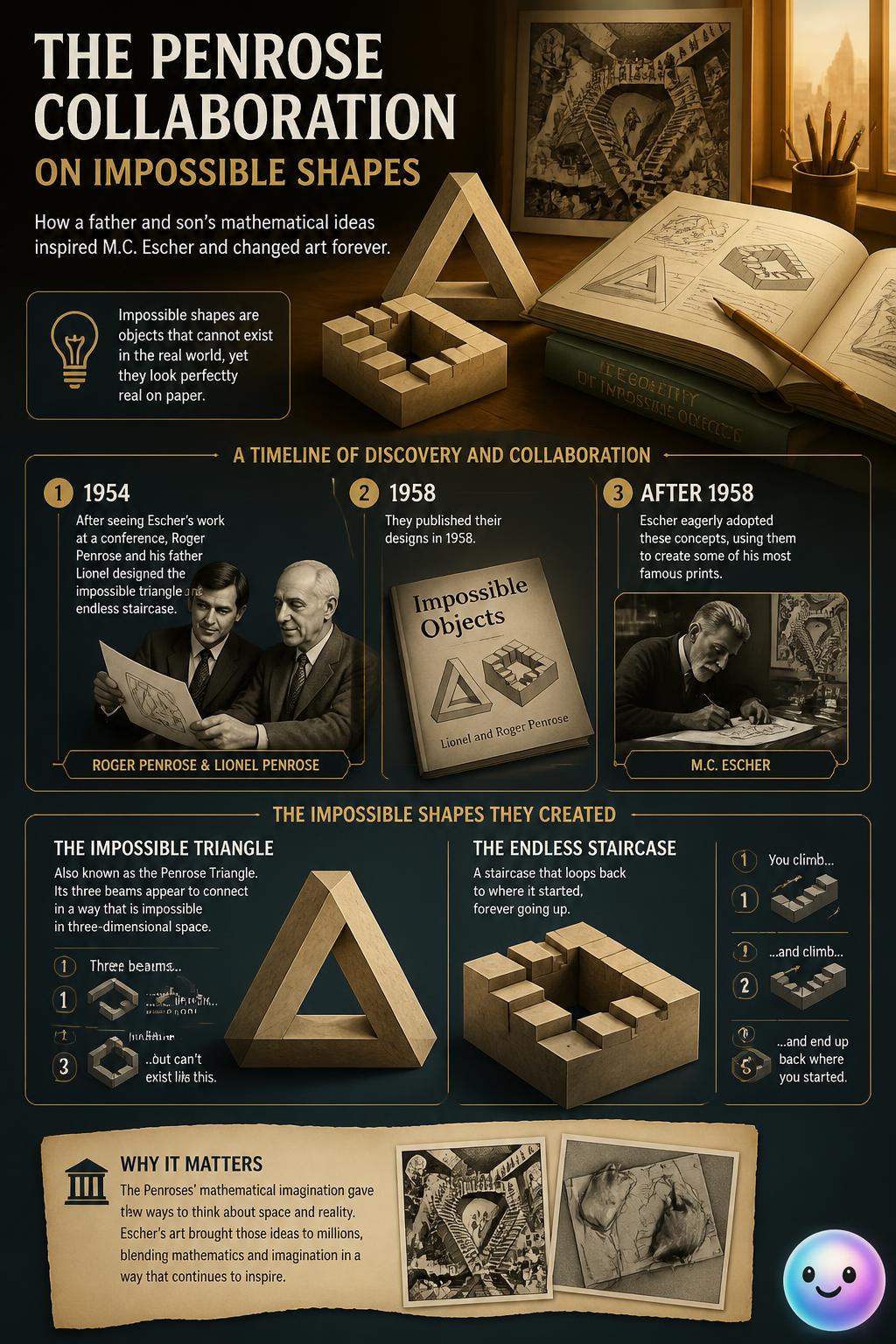
schopenhauer Escher's art inspired British mathematician Roger Penrose, leading to a creative loop of ideas that produced famous impossible objects.
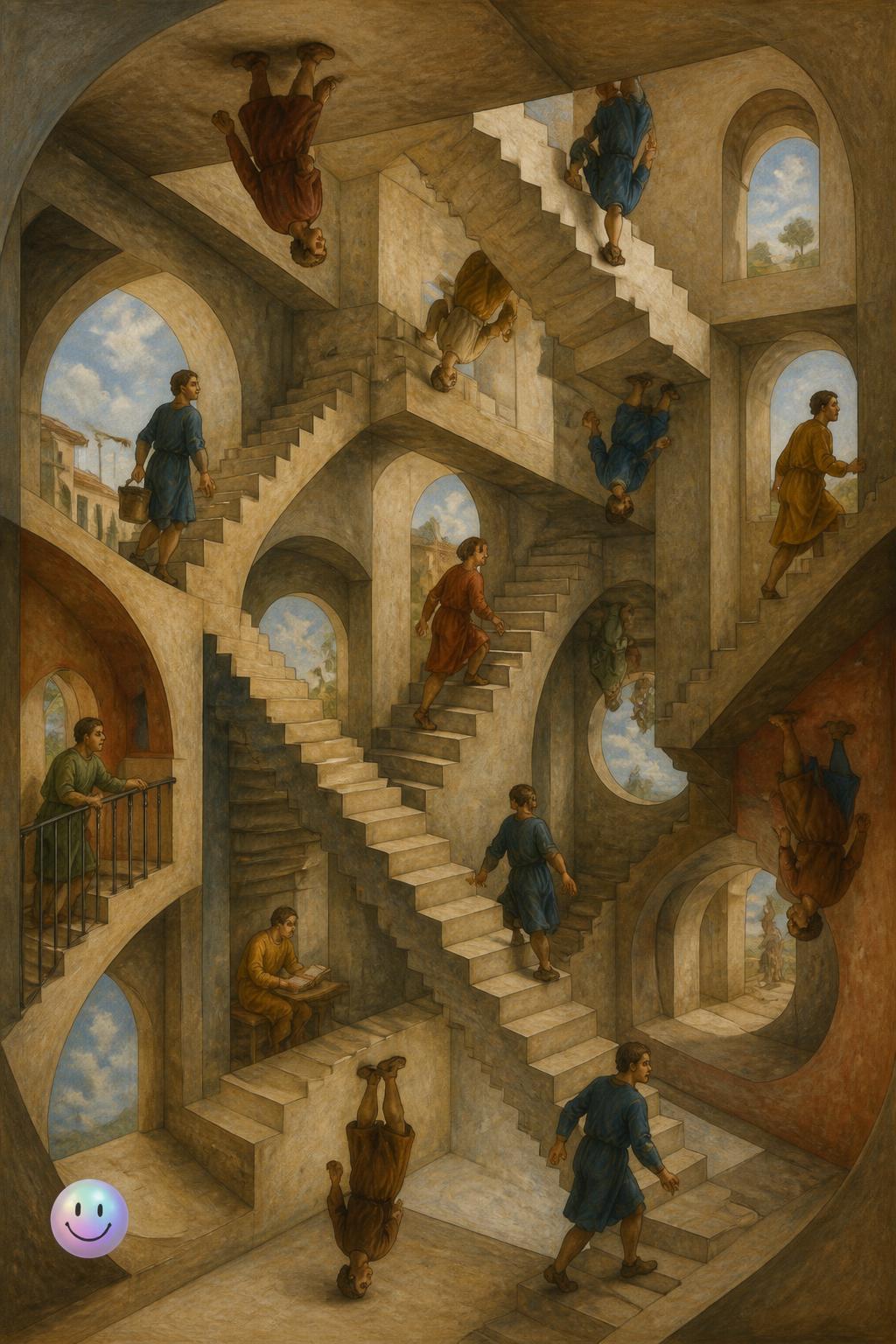
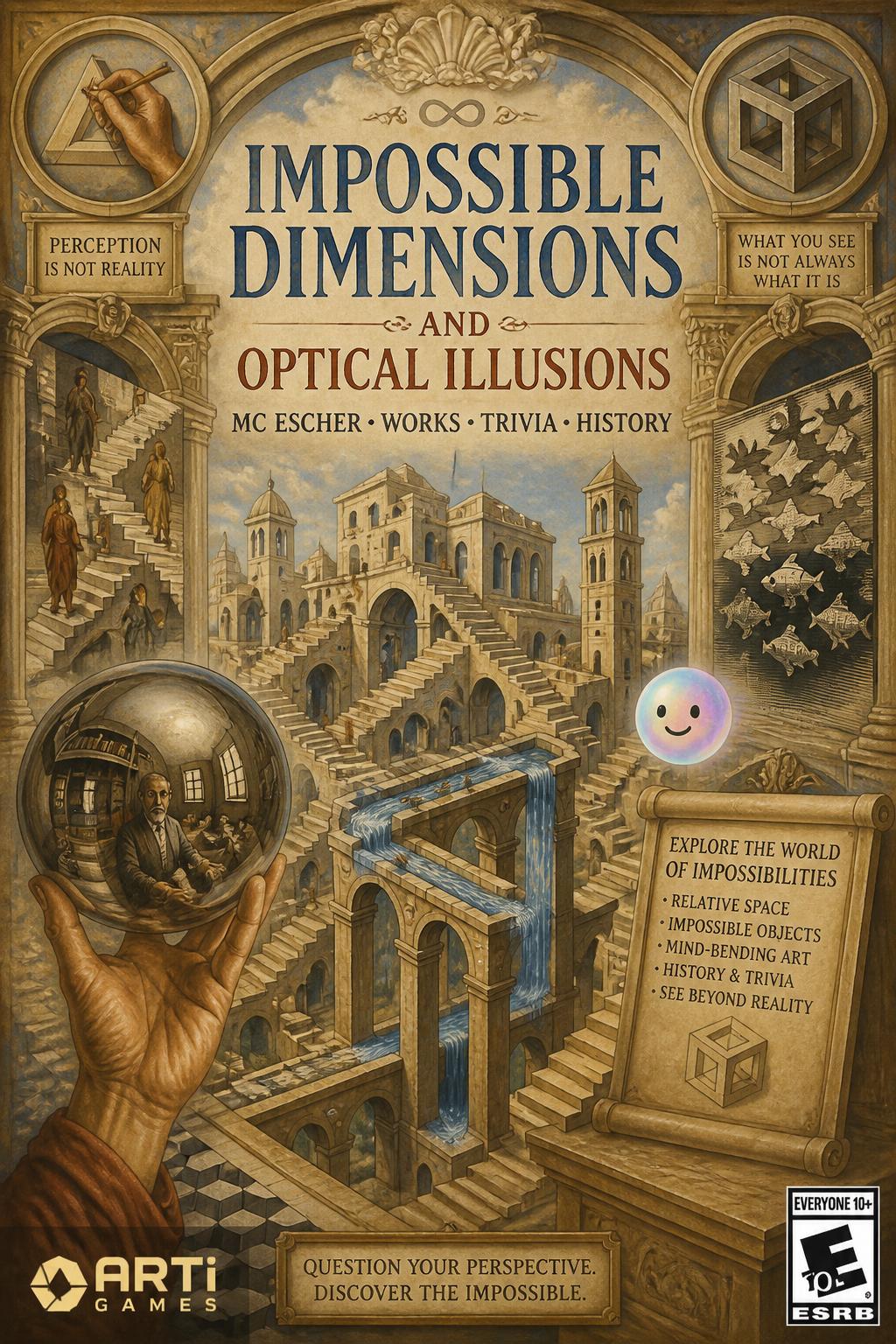
schopenhauer His famous 1953 print Relativity depicts a world with multiple gravities, where people walk on the same stairs in different directions.
BETA
schopenhauer Match the optical illusions to learn how Escher created his impossible dimensions.
Fun Fact
Penrose triangle origin: The famous impossible triangle was designed by Roger Penrose after being inspired by Escher's own exhibition in 1954.
Glossary
perspective (noun)
The representation of solid objects on a flat surface to produce an illusion of depth. In 1953, Maurits Escher manipulated these spatial rules to create the staircases of his print Relativity.
The representation of solid objects on a flat surface to produce an illusion of depth. In 1953, Maurits Escher manipulated these spatial rules to create the staircases of his print Relativity.
Quiz
Which 1953 M.C. Escher print features three different gravity sources and stairs that people walk on upside down?
Quiz
What impossible structure is featured in M.C. Escher's 1958 print 'Belvedere'?
Quiz
In the print 'Hand with Reflecting Sphere' (1935), what is the main object reflecting the artist's self-portrait?
Quiz
What mathematical concept is explored in M.C. Escher's 'Möbius Strip II' (1963) featuring red ants?
Quiz
Which printmaking technique involves drawing on a flat stone with a greasy crayon, which Escher used for 'Relativity'?
Quiz
Which impossible object, designed by a British mathematician, is the basis for M.C. Escher's 'Waterfall'?