
Erase a Bit, Release Heat: Information Entropy
According to Landauer's principle, erasing a single bit of digital information always dissipates a tiny, unavoidable minimum amount of heat, proving that computational logic is fundamentally bound by physical thermodynamics.
Chapter 1
The steam engine's secret
Chapter 2
The probability game
Chapter 3
The arrow of time
Chapter 4
Information and order
Ch 4 · Information and order

mankai In 1948, Shannon proved that information mathematically measures the amount of uncertainty in a message
mankai In 1961, a physicist proved that deleting information always releases a tiny, unavoidable amount of heat.
BETA
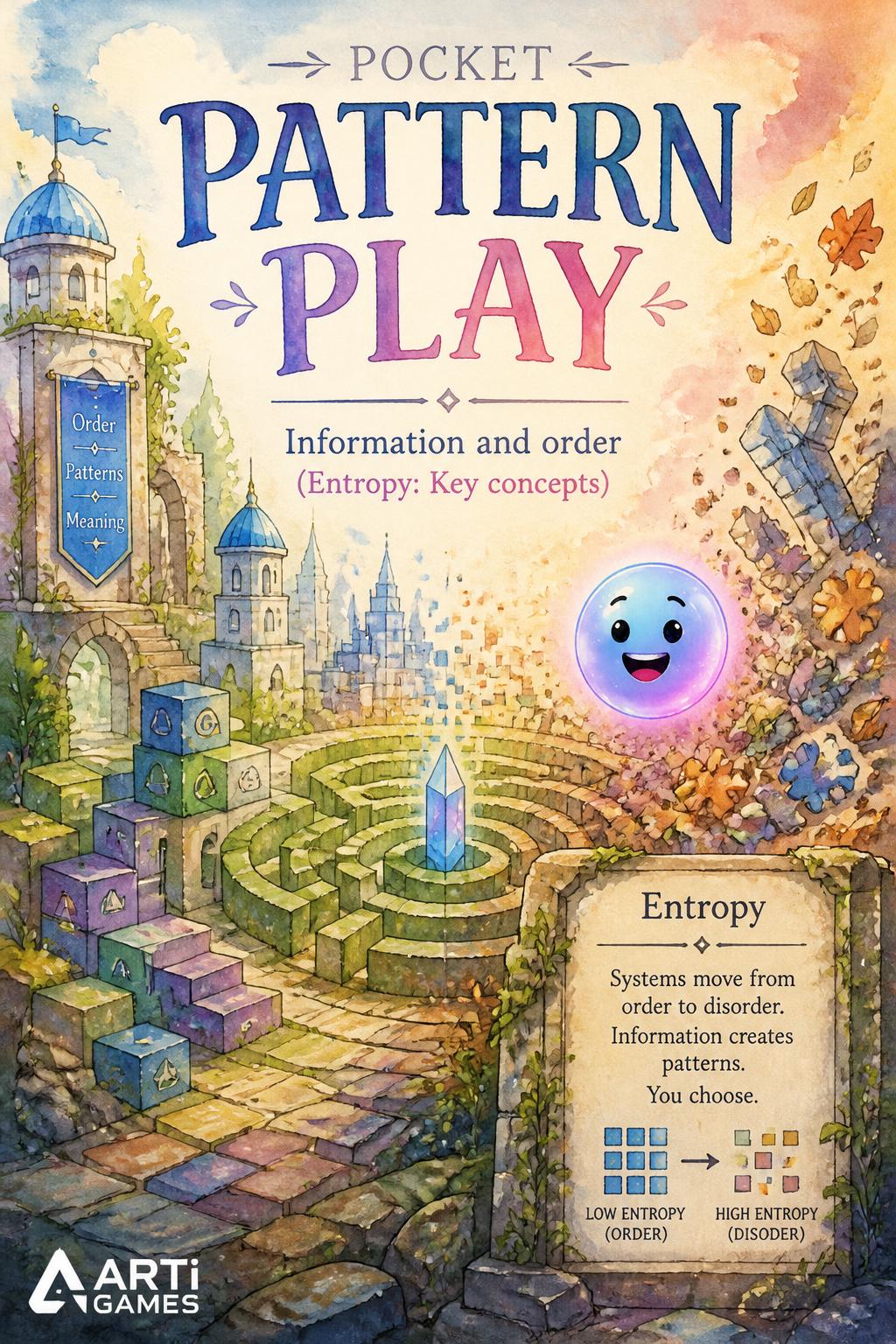
mankai Sort chaotic tiles into neat patterns to learn how entropy measures order and disorder.
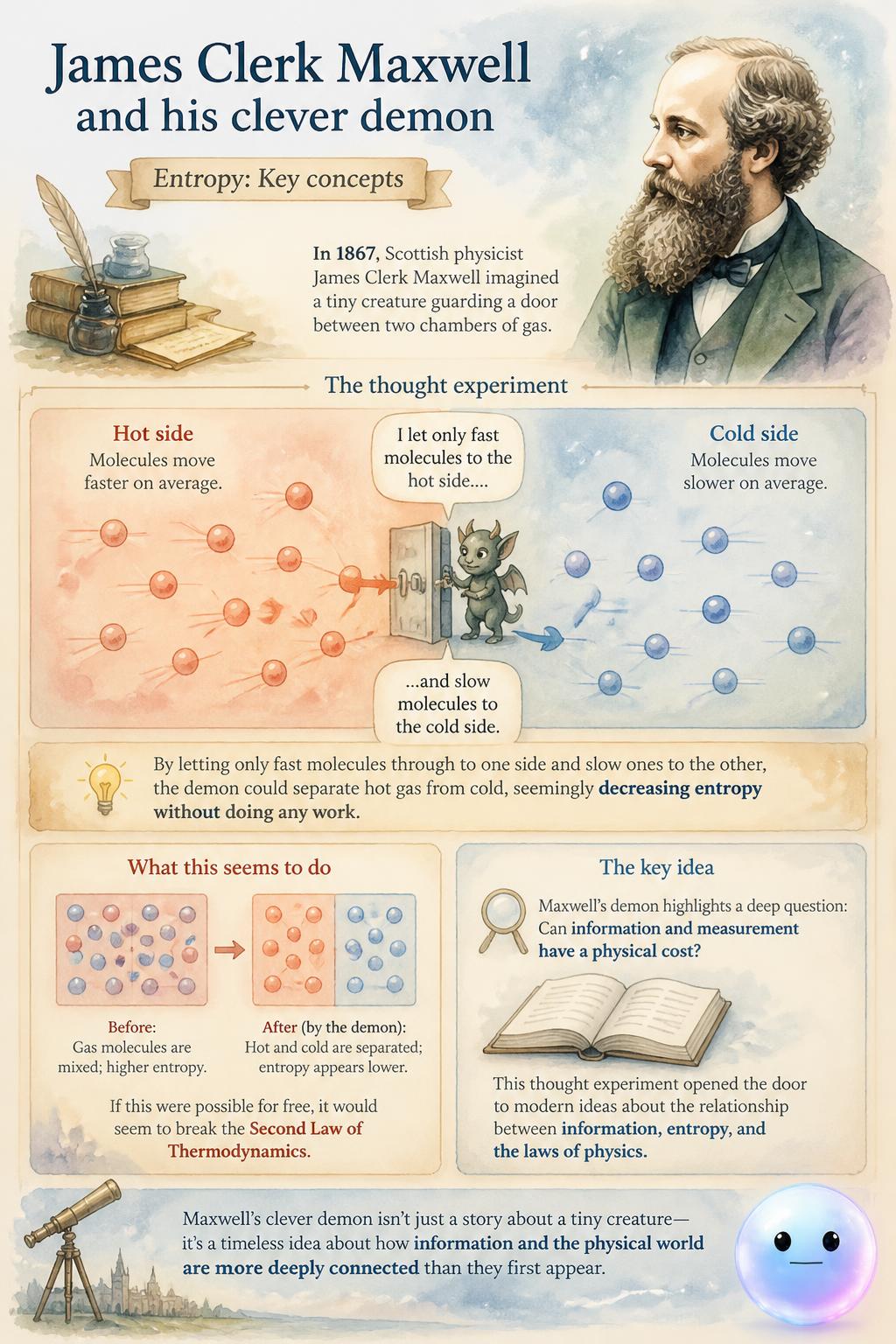
mankai A tiny creature guards a door between two gas chambers, sorting fast and slow molecules to separate hot and cold gas.
Quiz
Which Scottish physicist proposed the 'demon' thought experiment to challenge the second law of thermodynamics?
Fun Fact
Shannon's naming: John von Neumann advised Claude Shannon to name his information measure 'entropy' because no one knows what it is, so he would always win arguments.

Quiz
Who formulated the principle stating that erasing a single bit of information must always release heat?
Quiz
Why does Maxwell's demon ultimately fail to violate the Second Law of Thermodynamics?
Glossary
negentropy (noun)
The negative of entropy, representing a measure of order, organization, or information in a system. In 1971, Rudolf Arnheim explored how this measure of organization applies to visual structures in art.
The negative of entropy, representing a measure of order, organization, or information in a system. In 1971, Rudolf Arnheim explored how this measure of organization applies to visual structures in art.
Quiz
According to Claude Shannon's theory, what does information entropy measure in a communication message?
Quiz
In which year did Claude Shannon publish his groundbreaking paper defining information entropy?
Quiz
What is the slow, spontaneous degradation of digital data on storage media commonly called?