
Horror Movie Sound Secrets Statement sticker
Get this ARTi Statement sticker from the Thunder in the Back Row project. Eerie movie groans are just sloshing water! Share it like a card.
The kings of the kitchen
The mighty kettles that sing
From battlefield to concert hall
The physics of making a racket
Stealing the spotlight
maestro Striking the top drumhead forces air downward, violently rattling coiled metal wires against the bottom head. This rapid vibration creates the instrument's signature sharp snap.
maestro Violin strings vibrate in neat integer ratios to make clear notes. A flat drumhead wobbles in complex circular patterns, creating a dense cloud of clashing frequencies.
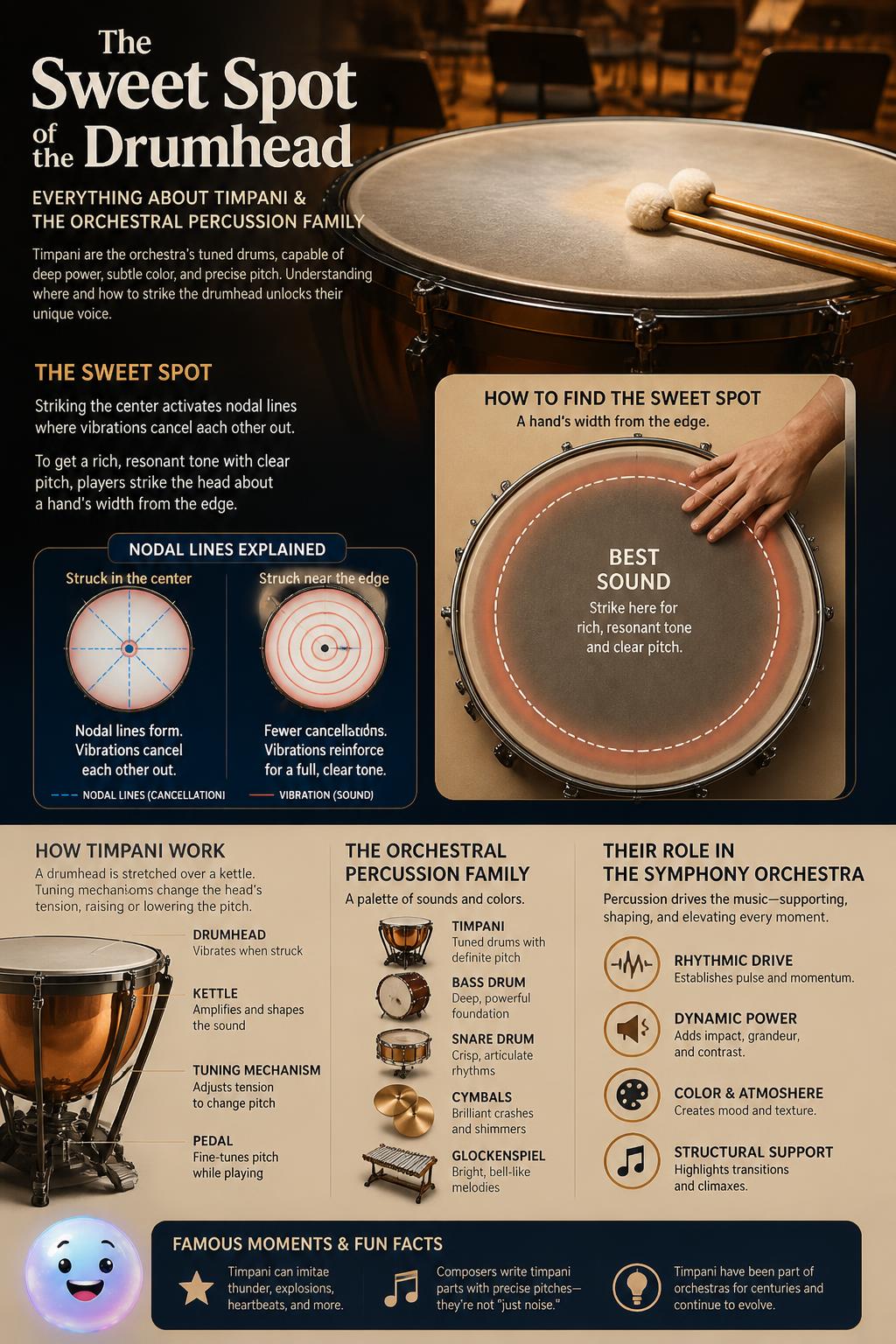
maestro Striking the exact center of a drumhead creates dead zones called nodal lines that cancel out sound. Moving a hand's width from the edge unlocks a rich, resonant tone.
maestro Striking the membrane pushes air inside the copper kettle. This acoustic coupling aligns chaotic vibrations into a perfect harmonic series, creating the instrument's signature clear tone.
maestro Timpani Acoustics
The air trapped inside the copper kettle Makes the overtones align as the vibrations settle.
Waterphone sounds: The eerie, metallic groans used in horror movie soundtracks are produced by a waterphone, a percussion instrument containing a small amount of sloshing water.

maestro Neon lines map chaotic sound waves turning into orderly frequencies inside a dark kettle.
The reinforcement or prolongation of sound by reflection or by synchronous vibration. Striking a timpani drumhead vibrates the air within its copper kettle, amplifying the fundamental pitch.
Where is the ideal striking zone on a timpani head to achieve the richest, clearest pitch?
What are the coiled metal wires stretched across the bottom of a snare drum called?
How does striking a drumhead with a harder mallet affect the acoustic frequencies produced?
What phenomenon causes an unplayed gong to hum when a brass instrument plays a matching note?