
Chapter 1
The magic of game feel and juicy feedback
Chapter 2
The invisible hand of level design
Chapter 3
Finding the perfect flow state
Chapter 4
The psychology of play
Ch 1 · The magic of game feel and juicy feedback
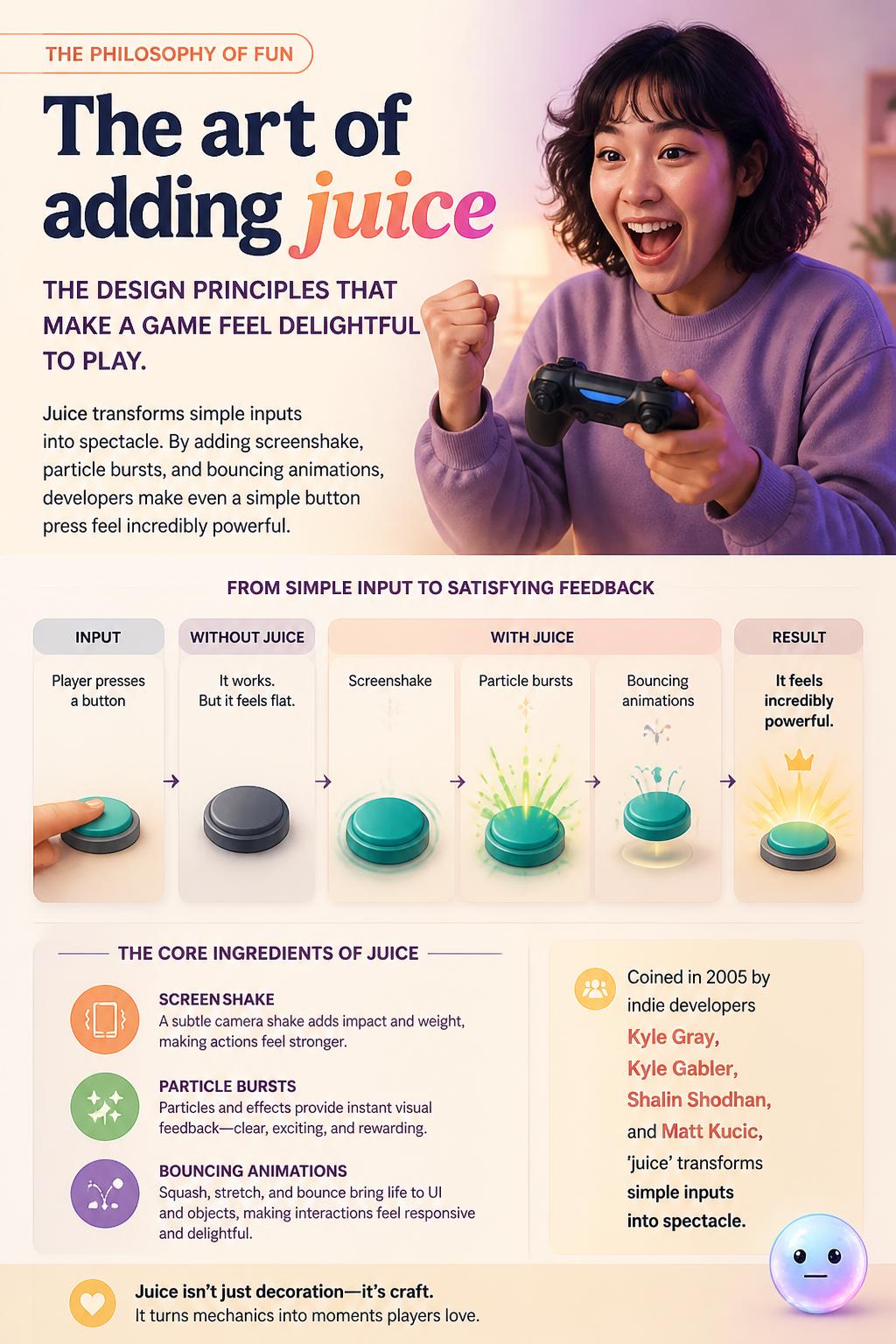
nintendo In 2005, developers Kyle Gray, Kyle Gabler, Shalin Shodhan, and Matt Kucic introduced juice to turn simple game inputs into spectacles.
Quiz
Who coined the game design term 'juice' in their 2005 article 'How to Prototype a Game in Under 7 Days'?
Quiz
Which visual effect is commonly used to add 'juice' by briefly rattling the camera during an impact?


nintendo Shigeru Miyamoto's 1996 physics tests defined the tactile game feel of modern platformers.
Quiz
In which 1996 game did Shigeru Miyamoto's team spend months testing movement in a blank room before building levels?
Quiz
What term did game designer Steve Swink use in 2008 to describe the tactile sensation of controlling virtual objects?
Fun Fact
Controller vibrations: The 1997 Nintendo 64 Rumble Pak was the first mainstream accessory to add physical touch feedback to video games.
nintendo Satisfying video game sound effects trigger powerful psychological responses.
Quiz
Which neurotransmitter is released in the brain when players experience satisfying sensory rewards in games?
Quiz
Which classical music piece plays at the end of a 'Peggle' level to create a highly satisfying victory sound?
Glossary
juiciness (noun)
The state or quality of being succulent, moist, or full of juice. Game designers Martin Jonasson and Petri Purho popularized this responsive feedback concept in their 2012 presentation.
The state or quality of being succulent, moist, or full of juice. Game designers Martin Jonasson and Petri Purho popularized this responsive feedback concept in their 2012 presentation.
nintendo Video Game Hit-Stop
We freeze the frame right when you hit to make the impact real
Quiz
What is the name of the technique where a game freezes for a few frames upon a successful hit to simulate impact resistance?
Quiz
In which genre of video games was the 'hitstop' technique initially popularized to emphasize combat impacts?