The philosopher who refused to look away
What real attention actually looks like
The battle for our brains
Attention as an act of love

artiteacher Tech companies turn our minds into products, directly opposing Simone Weil's vision of deep, voluntary attention.
What modern movement advocates for using technology selectively and mindfully to reclaim focus?

artiteacher Swipe away notifications to learn how deep attention saves you from the distraction economy.
artiteacher A Stanford study shows multitasking hurts focus, preventing the deep attention Simone Weil advocated.
artiteacher Scientific research confirms Weil's suspicion that human brains cannot truly focus on multiple things at once.
Which evolutionary survival mechanism do social media algorithms exploit by prioritizing alarming or negative news?
What is the modern term for obsessively scrolling through negative news feeds on your phone?
artiteacher The Battle for Our Brains
Just let it wait, just let it wait, That's how we win the battle today.
artiteacher Social media exploits our fear, blocking the calm attention Simone Weil argued we need for truth.
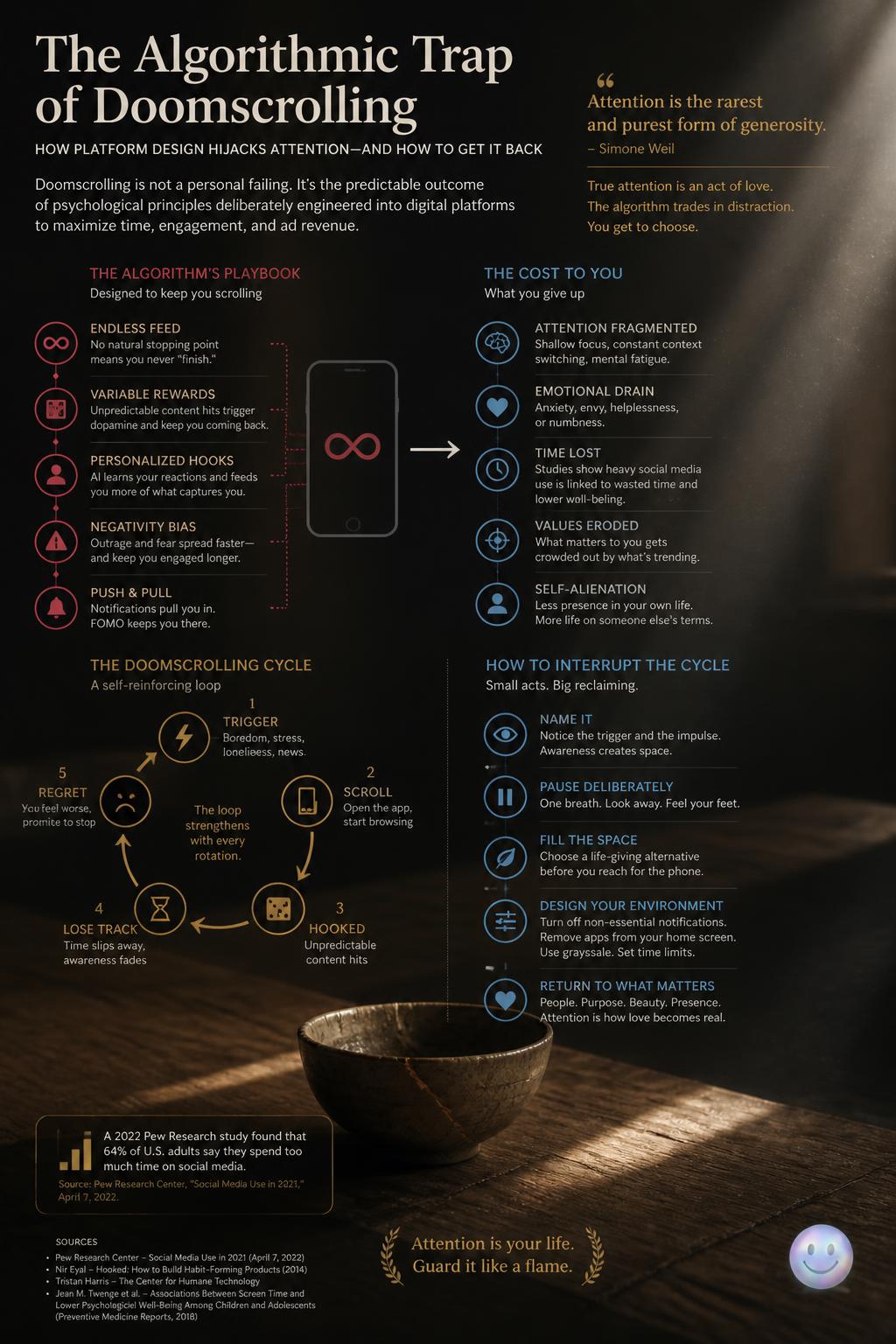
artiteacher Algorithms exploit our evolutionary survival instincts to keep us hooked on negative and shocking news.
What term describes how modern tech companies compete to capture and monetize human focus?
Which chemical neurotransmitter in the brain do social media notifications trigger to keep users hooked?
Goldfish attention myth: A famous but debunked study claimed humans now have shorter attention spans than goldfish, though real attention is task-dependent.
artiteacher Using basic phones and screen-free Sundays turns reclaiming our attention into a powerful act of political resistance.
A 2009 study from which university found that heavy media multitaskers are worse at filtering out distractions?
Which sensory experience did Simone Weil consider vital for deep thought, but is constantly interrupted by digital notifications?
The act or power of carefully thinking about, listening to, or watching someone or something. In 1942, Simone Weil defended this cognitive faculty against the fragmenting effects of repetitive factory work.