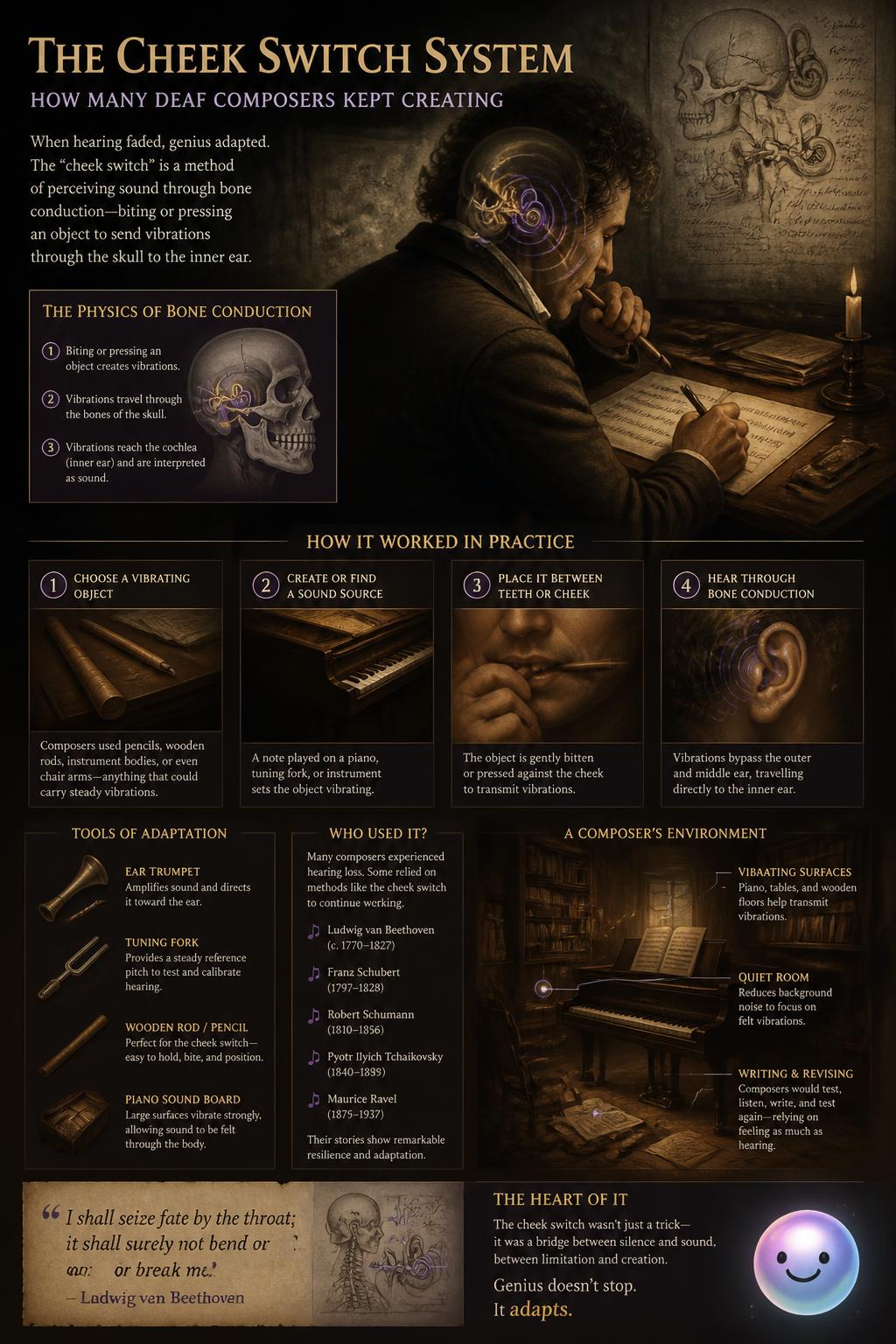
Beethoven's silent symphonies
FDR's wheelchair diplomacy
Frida Kahlo's canvas of pain
Stephen Hawking's cosmic mind
misslily At Cambridge, Stephen Hawking overcame depression after his ALS diagnosis to complete his PhD.
Which muscle did Stephen Hawking use to control his communication system after losing movement in his fingers?
At what university was Stephen Hawking studying when he was first diagnosed with ALS at age 21?
What famous physical phenomenon did Stephen Hawking discover that black holes emit, proving they are not completely black?

misslily Play this game about the hidden illnesses and disabilities of history's geniuses, including Stephen Hawking, Beethoven, and FDR.
misslily After losing his voice to pneumonia in 1985, Stephen Hawking used a computer program to speak.

misslily After a life-saving tracheostomy in 1985, Hawking lost his voice and began using a computer system to speak.
What is the name of the groundbreaking 1988 science book written by Stephen Hawking that sold millions of copies?
Which tech company's engineers developed the ACAT system to help Stephen Hawking communicate using his cheek muscle?
What medical procedure in 1985 saved Stephen Hawking's life but permanently took away his natural voice?
misslily Stephen Hawking's Cosmic Mind
He couldn't write equations on a page, So he mapped the cosmos on a mental stage.
misslily Among history's disabled geniuses, Stephen Hawking wrote books using a sensor that detected his cheek movements.
misslily As Hawking lost control of his fingers, he adapted his communication system to be controlled by a single cheek muscle.
In what year did Stephen Hawking pass away, having defied his initial two-year prognosis by more than five decades?
What is the full name of the motor neuron disease (ALS) that Stephen Hawking lived with for over 50 years?
Hawking's voice: Stephen Hawking chose to keep his famous computerized voice even after newer, more natural-sounding options were developed.
A progressive neurodegenerative disease that affects nerve cells in the brain and spinal cord, leading to loss of muscle control. Stephen Hawking was diagnosed with the condition in 1963 while studying theoretical physics at Cambridge University.