
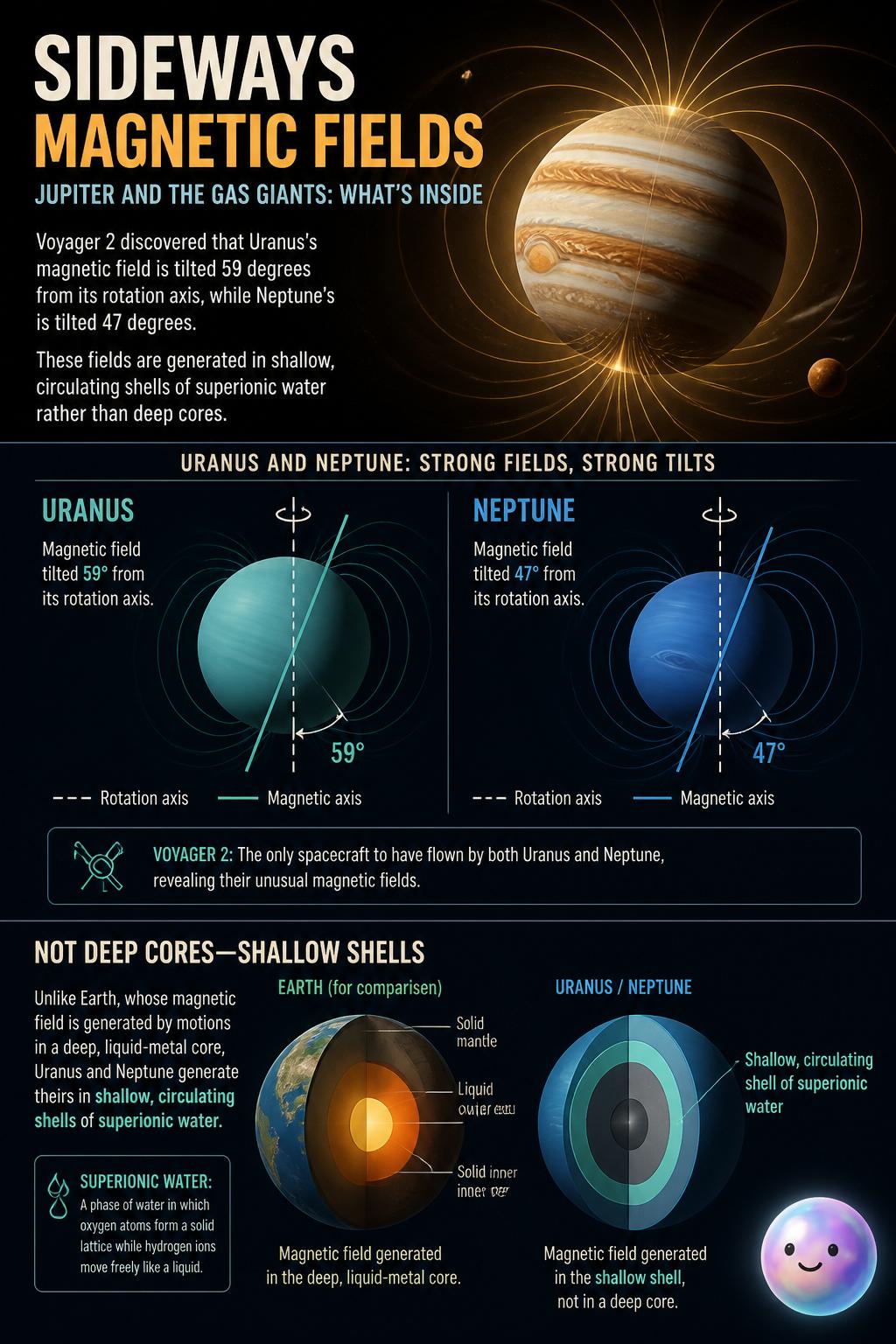
Sideways magnetic fields
Voyager 2 discovered that Uranus's magnetic field is tilted 59 degrees from its rotation axis, while Neptune's is tilted 47 degrees. These fields are generated in shallow, circulating shells of superionic water rather than deep cores.
Jupiter's metallic hydrogen ocean
Saturn's diamond rain and helium storm
Uranus and Neptune's hot icy mantles
The fuzzy cores at the center


artiteacher Uranus and Neptune's Mantles
Deep in the pressure, carbon is squeezing, diamonds are raining down!
Uranus's tilt: Uranus is the only planet that rotates completely on its side, rolling like a bowling ball around the Sun instead of spinning like a top.

artiteacher Extreme pressures create a state where hydrogen ions flow through solid oxygen.
A giant planet composed mostly of elements heavier than hydrogen and helium, such as water, ammonia, and methane. Voyager 2's 1986 and 1989 flybys confirmed the highly pressurized fluid interior structures of Uranus and Neptune.
What is the name of the bizarre state of water where oxygen freezes but hydrogen flows?
Why are the magnetic fields of Uranus and Neptune so unusual compared to Earth's?
In what year did laboratory scientists first successfully recreate superionic ice?