Bending light inside glass
The deep sea cable network
Beaming data through thin air
Translating data into photons
play_review Watch how total internal reflection is used to move internet data using beams of light.
In what decade did physicists successfully demonstrate the first flexible glass fiber optic bundles?
play_review Bending Light in Glass
Bounce in the glass, flashing so fast, we're surfing the beam!
play_review Narinder Singh Kapany designed coated glass fibers that prevent light leaks, enabling modern internet cables.
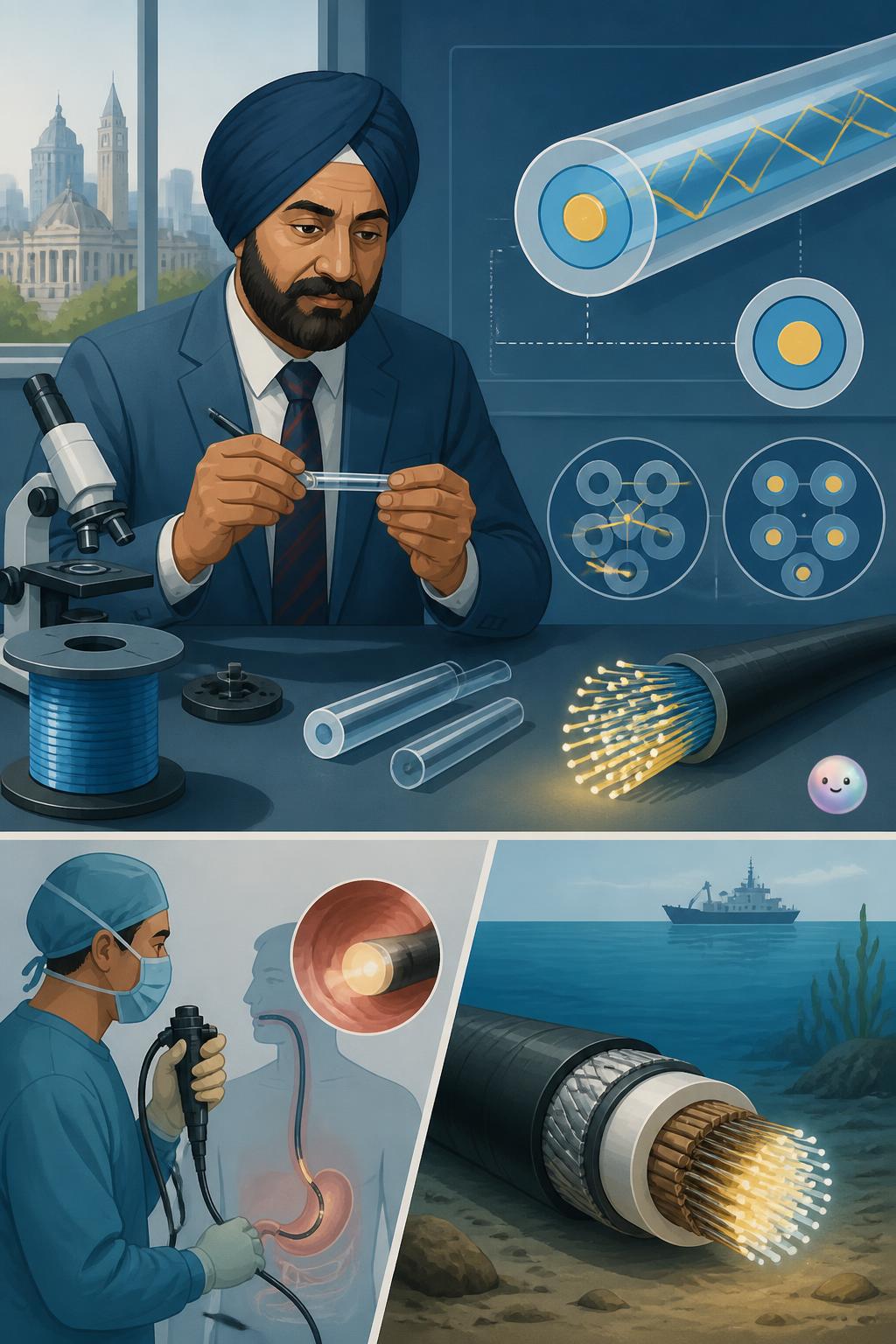
play_review In 1953, physicist Narinder Singh Kapany successfully transmitted high-quality images through a bundle of glass fibers, coining the term fiber optics.
Which part of a fiber optic cable has a lower refractive index to keep light bounced inside the core?
Water pipe light: In 1840, Swiss physicist Daniel Colladon demonstrated light guiding by shining a lantern into a pouring stream of water.
play_review Charles Kao won a Nobel Prize for proving that purifying glass fibers lets light carry data farther.
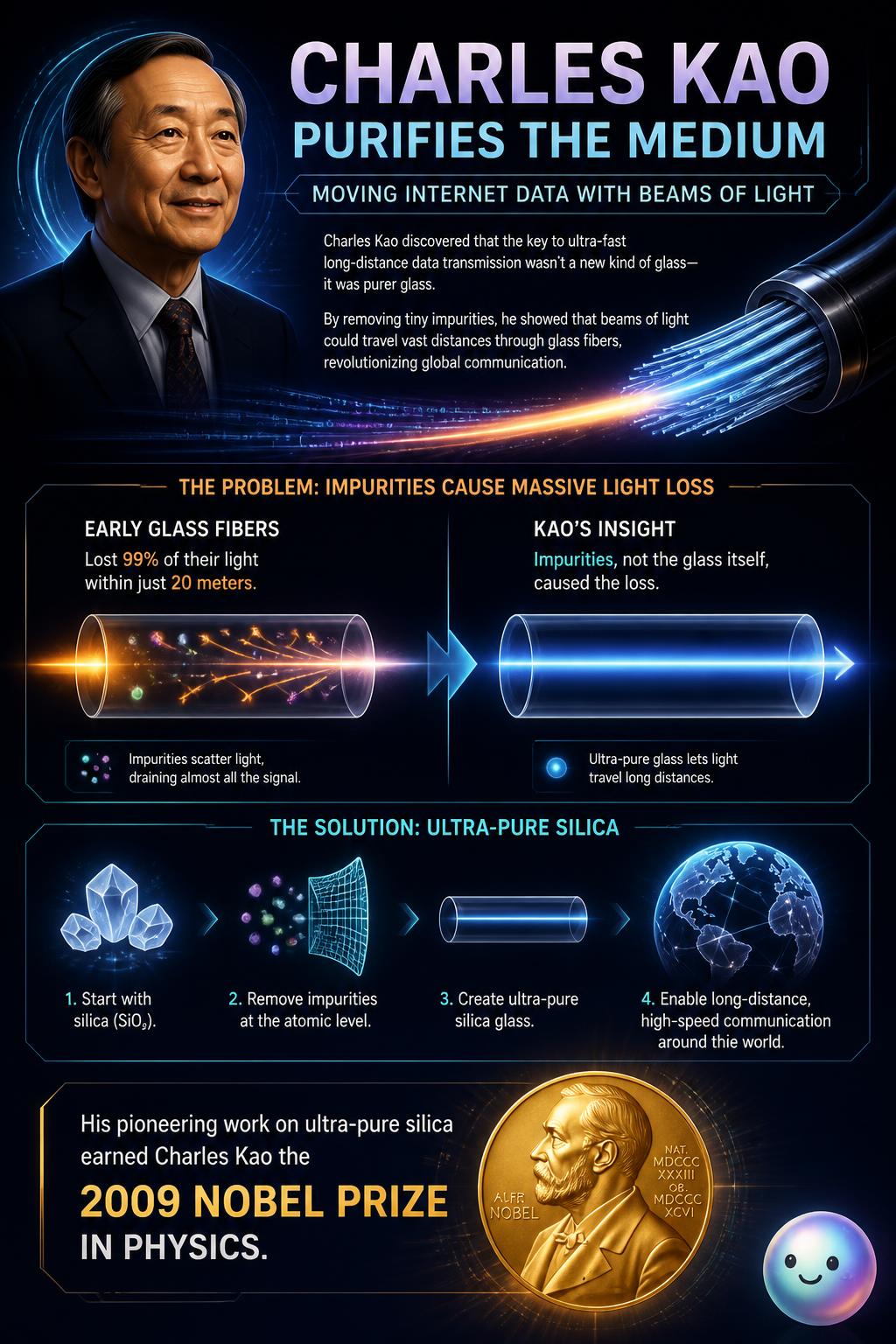
play_review Engineer Charles Kao discovered in 1966 that purifying glass could allow light signals to travel for miles without fading.
Compared to copper wires, why is fiber optic data transmission immune to electromagnetic interference?
The complete reflection of a light ray back into its original medium when hitting a boundary at an angle larger than the critical angle. In 1870, John Tyndall demonstrated this phenomenon, which today traps light inside glass to transmit internet data.
play_review Discover the internal structure of a fiber optic cable and see how its components work together to transmit high-speed internet data using light.
Which material is primarily used to make the ultra-pure core of modern fiber optic cables?

play_review Steer light beams through fiber cables to discover how the internet moves data.
Who coined the term 'fiber optics' after successfully transmitting images through glass bundles in 1953?