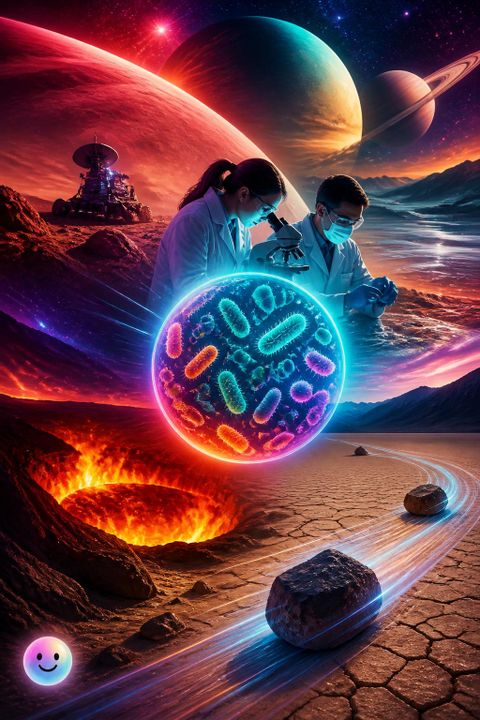
What extremophiles teach us about space
Studying bacteria in the Darvaza crater helps astrobiologists search for life on other planets.
Chapter 1
The fiery history of the Door to Hell
Chapter 2
The sliding stones of Death Valley
Chapter 3
Cracking the scientific codes
Chapter 4
Extreme life in extreme places
Ch 4 · Extreme life in extreme places
misslily Door to Hell Karakum
In Turkmenistan's Karakum, There's a giant fire pit, the Door to Hell. It's been burning non-stop for over five decades, A truly extreme, fiery, wonder.
misslily In 2013, George Kourounis found extremophile bacteria thriving inside the hot Door to Hell crater.


misslily Despite the extreme heat of Death Valley, rare pupfish survive in highly saline, warm desert pools.
Fun Fact
Alien-like bacteria: The bacteria found inside the burning Darvaza crater can eat methane and survive temperatures that would instantly kill humans.

misslily Studying bacteria in the Darvaza crater helps astrobiologists search for life on other planets.
Glossary
extremophile (noun)
An organism that thrives in physically or geochemically extreme conditions detrimental to most life on Earth. In 2013, explorer George Kourounis collected these bacteria from the bottom of Turkmenistan's burning Darvaza crater.
An organism that thrives in physically or geochemically extreme conditions detrimental to most life on Earth. In 2013, explorer George Kourounis collected these bacteria from the bottom of Turkmenistan's burning Darvaza crater.
Quiz
What makes the environment inside the Darvaza gas crater so hostile to normal life?
Quiz
Why are tourists banned from walking on Death Valley's Racetrack Playa when it is wet?
Quiz
What are organisms that thrive in extreme environments, like the Darvaza gas crater, called?
Quiz
What did scientists find living in the soil at the bottom of the Darvaza gas crater?
Quiz
Why are space scientists interested in the bacteria found in the Darvaza gas crater?
Quiz
What temperature does the water in Death Valley's Devils Hole stay at year-round?
Quiz
Which scientific field studies the possibility of life on other planets using Earth's extreme environments?