How Mario's World Fit on Tiny Microchips
Pixel diagrams illustrate how a white cloud shape recolors into a green bush.
The accidental hero of the arcade
Designing a masterpiece on graph paper
The leap into the third dimension
A global cultural phenomenon

nintendo In 1984, Shigeru Miyamoto and Takashi Tezuka hand-drew every Super Mario Bros. level on grid paper. They taped correction paper over mistakes and coded each coordinate by hand.
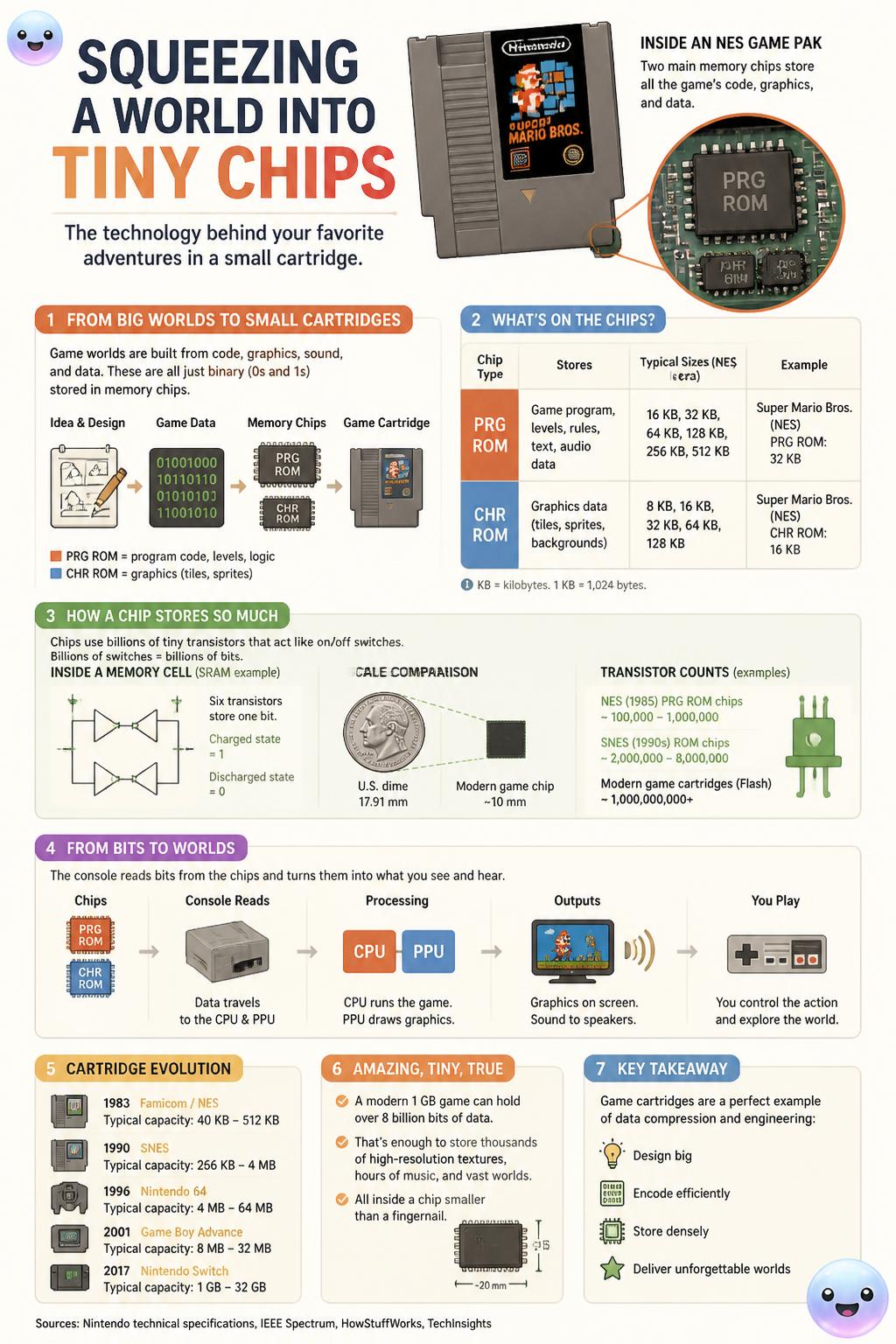
nintendo The 1985 NES cartridge held only 40 kilobytes of data. Developers recycled the same pixel art sprite for both clouds and bushes by simply changing the color palette.
nintendo Nintendo released this masterpiece in 1985 to guide players without text. An unavoidable Goomba and a bouncing mushroom teach movement and power-ups instantly through clever obstacle placement.
nintendo Game designers debuted Luigi in the 1983 arcade game Mario Bros. They colored him green to match the pipes and save limited computer memory.

nintendo Assemble the paper blueprints to learn how Mario went from carpenter to plumber.
nintendo Mario's Graph Paper Origins
Grid paper plans, tracing paper sheets, watch the plumber run!
nintendo Pixel diagrams illustrate how a white cloud shape recolors into a green bush.
The cloud-bush secret: In the 1985 Super Mario Bros., the white clouds in the sky and the green bushes on the ground are the exact same sprite.
nintendo Green pipes, brick blocks, and a mushroom form a stylized video game landscape.
Paper printed with a network of small squares of equal size, used for drawing charts or plotting curves. In 1985, Shigeru Miyamoto and Takashi Tezuka sketched the original Super Mario Bros. levels on this paper.
Which two environmental objects in Super Mario Bros. share the exact same pixel sprite shape?
In what year was Super Mario Bros. released for the Nintendo Entertainment System?