Chapter 1
The lying eye and how optical illusions hack your sight
Chapter 2
The rewrite machine and why memory is a puzzle
Chapter 3
Blind spots and the shortcuts your brain takes to save energy
Chapter 4
Cultural lenses and how background shapes what we see
Ch 4 · Cultural lenses and how background shapes what we see

artiteacher Culture and Visual Perception
See the background! See the background! Do you see the seaweed or just the fish?
BETA
artiteacher Adjust the lenses to discover how your brain tricks you into seeing optical illusions.
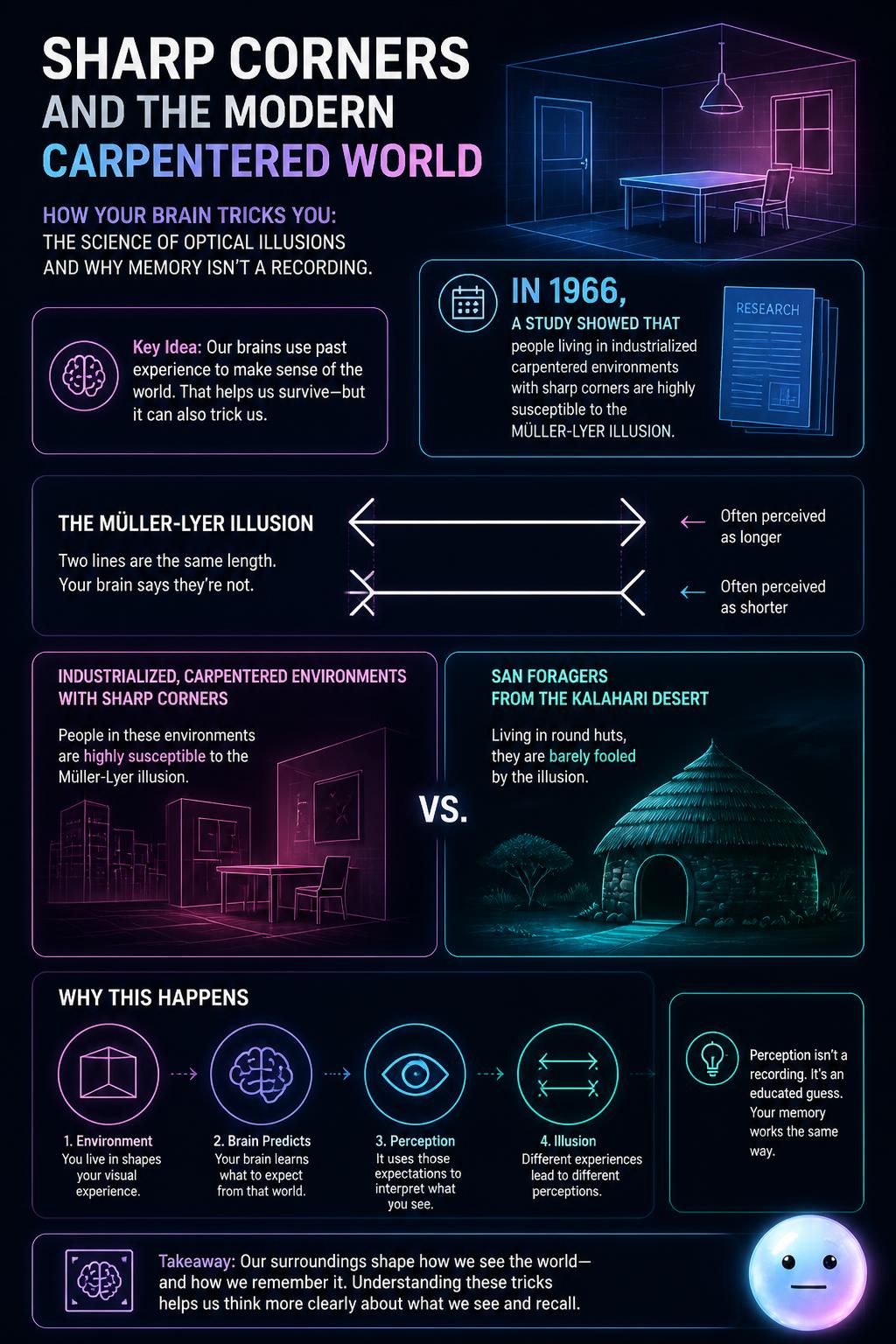
artiteacher Kalahari Desert San foragers living in round huts resist the Müller-Lyer illusion, which easily tricks people from industrialized, sharp-cornered environments.
Quiz
Which famous visual illusion features two lines of equal length ending in inward or outward-pointing arrows?
Quiz
Which group of people living in the Kalahari Desert showed high resistance to the Müller-Lyer illusion in the 1966 study?

artiteacher Language actively shapes visual brain centers, changing how people perceive and recall color.
Quiz
Which language has separate, mandatory words for light blue and dark blue, helping its speakers distinguish shades faster?
Quiz
Which Namibian tribe, known for having many words for green but few for blue, was studied for their unique color perception?
Fun Fact
Pigeon visual skills: Pigeons can be trained to distinguish between paintings by Picasso and Monet, showing that complex visual categorization is not unique to humans.
Quiz
In the 2001 study on cultural visual attention, which group focused significantly more on the background elements of a scene?
Quiz
What is the term for visual processing that focuses on the relationships between objects and their surrounding context?
Glossary
carpentered-world hypothesis (noun)
A theory proposing that people raised in environments dominated by straight lines and right angles are more susceptible to geometric visual illusions. In 1966, researchers found that Kalahari hunter-gatherers rarely fell for the Müller-Lyer illusion.
A theory proposing that people raised in environments dominated by straight lines and right angles are more susceptible to geometric visual illusions. In 1966, researchers found that Kalahari hunter-gatherers rarely fell for the Müller-Lyer illusion.
Quiz
The 'other-race effect' is primarily caused by which brain mechanism developed through childhood exposure?
Quiz
In which year was the 'other-race effect' in facial recognition first scientifically documented?