The Slow Leak of Inflation Explained
Inflation happens when the supply of money grows faster than the supply of goods, or when production costs rise. Most central banks aim for a steady 2 percent annual inflation rate to keep people spending rather than hoarding cash. While mild inflation is normal, it means a dollar today buys less than a dollar did fifty years ago.
The giant scale of gross domestic product
When money loses its magic
The puzzle of finding a job
The wizards of the interest rate
The government's giant checkbook

marcus Japan entered its Lost Decades in 1991 when falling prices caused shoppers to delay purchases. This lack of spending forced businesses to cut wages and lay off workers.
marcus The United States formalized this system in 1913 using everyday items like milk and gasoline. Today, economists swap outdated cassette tapes for smartwatches to keep measurements accurate.
marcus In 1923, Germany printed massive amounts of marks to pay war debts, triggering extreme hyperinflation. Families burned banknotes for heat while workers bought bread before prices doubled daily.
marcus Printing money faster than producing goods slowly shrinks the value of cash. Central banks target a two percent annual rate to keep people spending instead of hoarding dollars.

marcus Adjust the interest rate slider to learn how central banks stop runaway inflation.

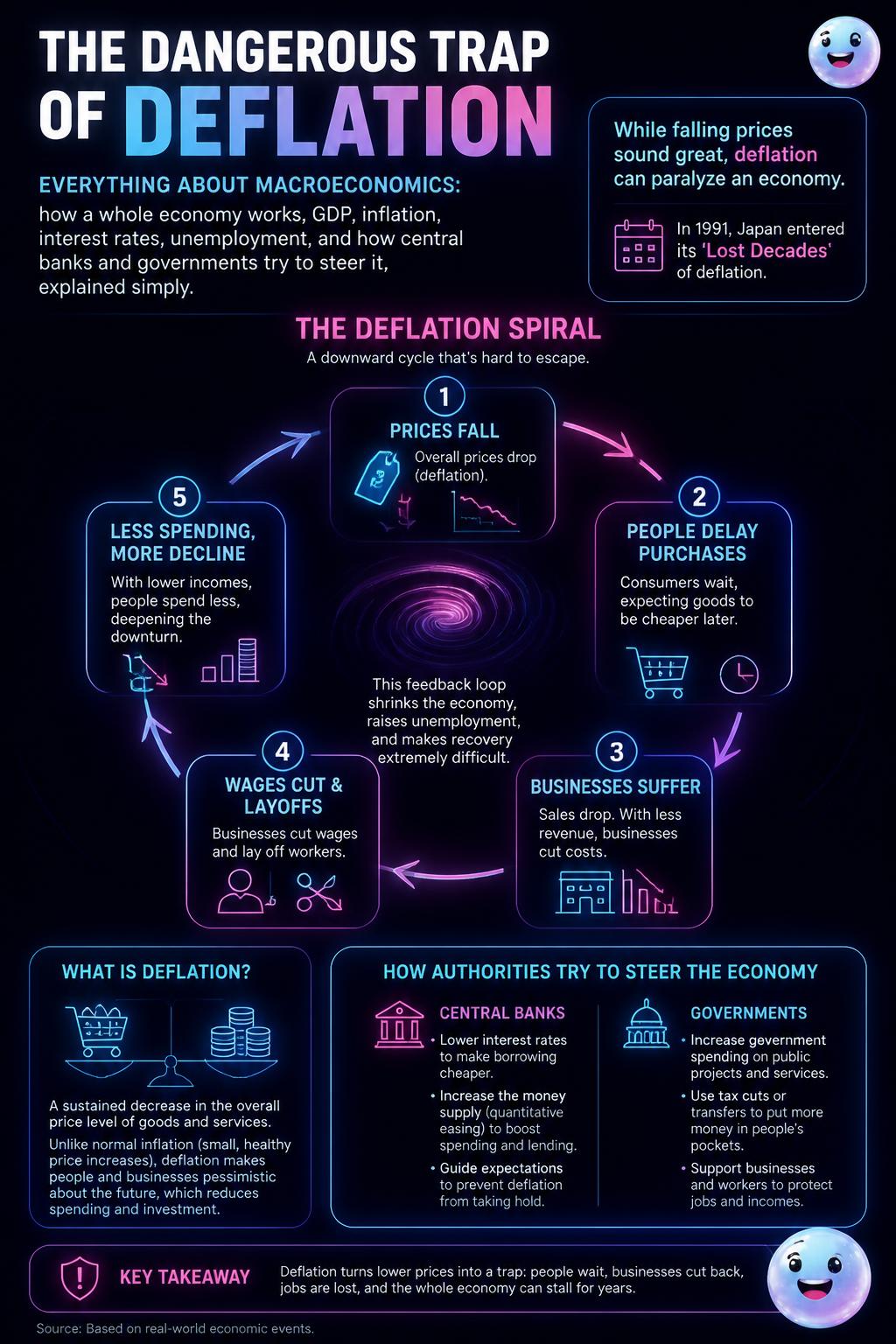
marcus A simple macroeconomic chart illustrates how governments and central banks steer the economy.
Zimbabwean trillionaires: During Zimbabwe's peak hyperinflation in 2008, the central bank printed a 100-trillion-dollar bill, which could barely buy a single loaf of bread.

To officially strip a currency of its status as legal tender. In 2016, India implemented this policy to combat corruption and curb the circulation of untaxed paper wealth.
What index did the US Bureau of Labor Statistics introduce in 1913 to track changes in consumer prices?
Would you rather deal with mild inflation or mild deflation in your daily shopping?
In which year did Weimar Germany experience its famous hyperinflation, where money became cheaper than firewood?
What happens to the purchasing power of a currency when an economy experiences inflation?
What type of inflation occurs when rising costs of raw materials and wages force prices up?
Which country entered a multi-decade period of deflation and stagnation known as the 'Lost Decades' starting in 1991?
Which African nation experienced hyperinflation so severe in 2008 that it printed a 100-trillion-dollar bill?