
Nissan Z: The Golden Ratio of Sports Cars
In 1966, Yoshihiko Matsuo led the design team that sculpted the S30's fastback body. By pushing the cabin rearward, they created a dynamic silhouette that mimicked expensive European GT cars while remaining highly aerodynamic.
The birth of a disruptor
Anatomy of an icon
The evolution of speed
Pop culture and the streets
The great comeback and the electric future


yuki Nissan Z design anatomy
A golden ratio styles the fastback frame, A timeless shape that built a legendary name.
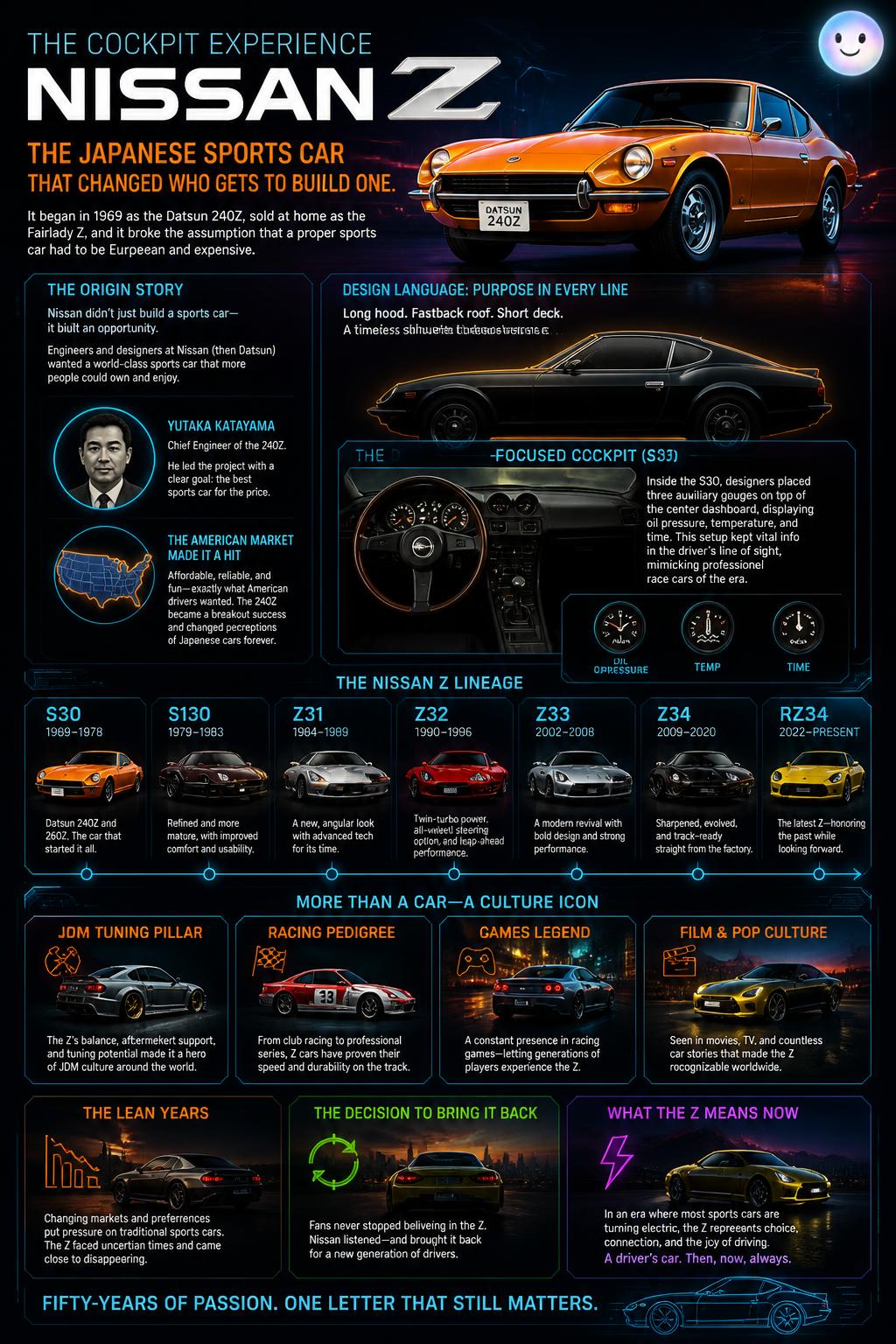
yuki The Z's driver-focused interior featured a distinctive trio of dashboard-mounted gauges angled toward the driver.
Smelly solution: The original 240Z's hatch had one-way air vents to prevent exhaust fumes from being sucked back into the cabin.

yuki The original Z relied on a smooth, reliable inline-six engine derived from luxury sedan technology.
An automotive design characterized by a single continuous slope from the roof to the rear bumper. The 1969 Datsun 240Z adopted this sloping roofline alongside a long hood to define its signature silhouette.
What was the primary functional purpose of the original 240Z's integrated rear deck spoiler lip?
What was the designation code for the first-generation Nissan Z platform launched in 1969?
Who was the lead designer responsible for the iconic styling of the original S30 Datsun 240Z?