
The evolutionary path of giant rodents
Fossil records show that capybaras belong to the family Caviidae, which diverged about 20 million years ago. Their closest extinct relatives, like the Josephoartigasia, were the size of bulls, weighing up to 2,000 pounds. Today's capybara, Hydrochoerus hydrochaeris, is the largest surviving rodent on Earth.
Chapter 1
The ultimate giant rodent
Chapter 2
Life in the wetlands
Chapter 3
The ultimate social butterfly
Chapter 4
Global sensations and cultural icons
Ch 1 · The ultimate giant rodent

artiteacher The ultimate giant rodent
Just floating, just floating, Keep your nose above the stream!
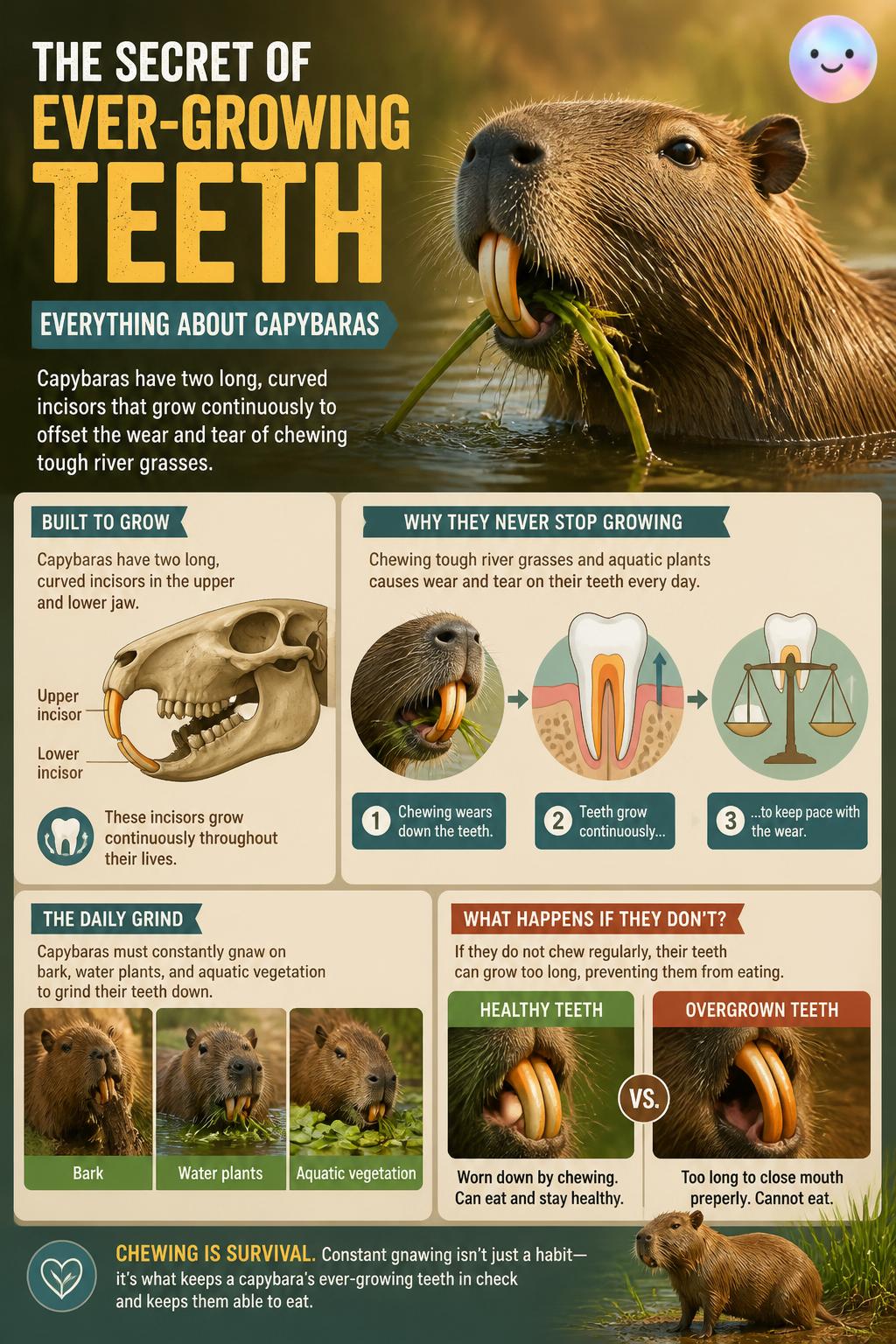
artiteacher Like all rodents, capybaras have teeth that never stop growing throughout their lives.
Fun Fact
Webbed feet: Capybaras have webbed toes that act like natural flippers, helping them swim and navigate muddy riverbanks without sinking.

artiteacher Capybaras possess unique physical adaptations that make them expert semi-aquatic swimmers.
Glossary
capybara (noun)
A large semiaquatic South American rodent with partially webbed feet and no tail. This mammal can weigh up to 140 pounds and is native to the wetlands of South America.
A large semiaquatic South American rodent with partially webbed feet and no tail. This mammal can weigh up to 140 pounds and is native to the wetlands of South America.
Quiz
How much can an adult capybara weigh, making it the largest rodent in the world?