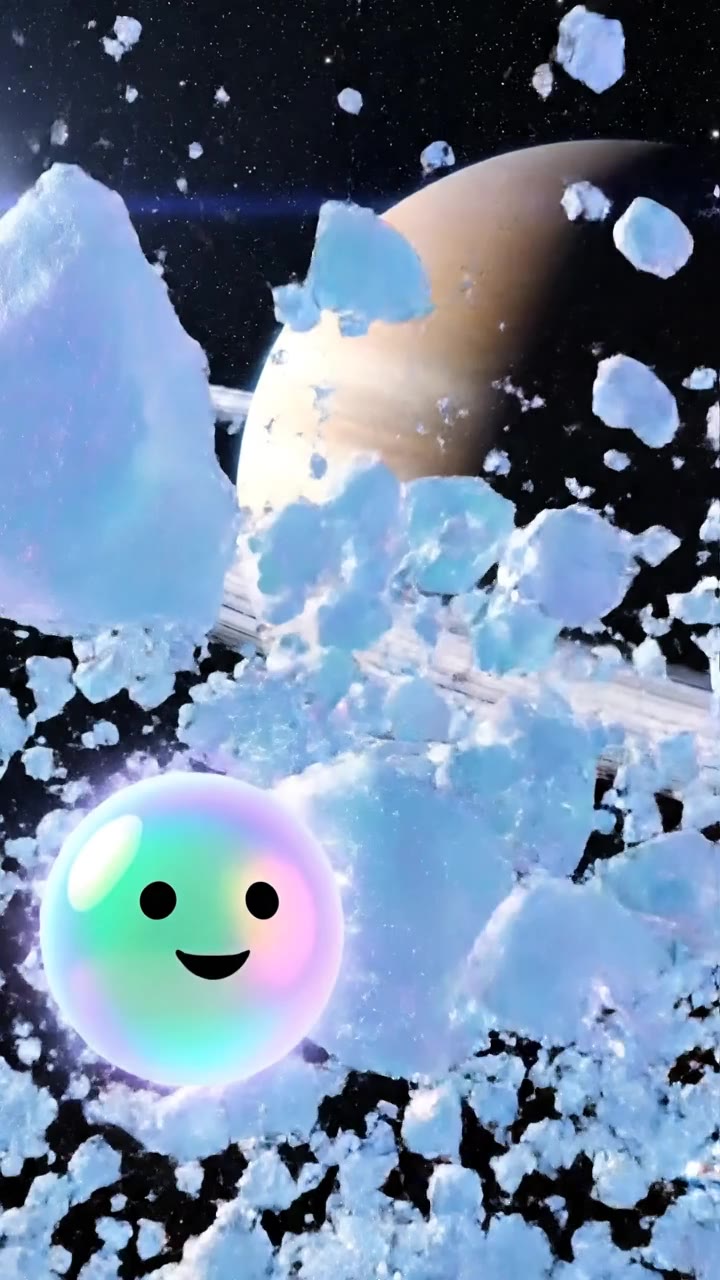
Deciphering the optical illusion
Saturn's rings are not solid structures, but are actually composed of billions of individual particles of water ice and rocky dust orbiting the planet at high speeds.
The frozen debris field
Deciphering the optical illusion
The cosmic traffic controllers
A temporary cosmic masterpiece

artiteacher James Clerk Maxwell proved that Saturn's rings must consist of countless tiny, independent orbiting particles.
artiteacher Giovanni Cassini discovered a gap in Saturn's rings, proving they are not a single, unbroken sheet.
artiteacher In 1659, Christiaan Huygens discovered that a thin, flat, unattached ring surrounds Saturn.
artiteacher Galileo's primitive telescope could not see Saturn's rings clearly, so he mistook them for two flanking bodies.

artiteacher Decode the ring riddle to discover what Saturn's rings are really made of.
artiteacher Deciphering the optical illusion
They look like solid silver bands shining in the night, But billions of icy particles are dancing in the light.

artiteacher In 1675, astronomer Giovanni Domenico Cassini discovered a massive dark gap dividing Saturn's rings into two distinct major sections.
Galileo's confusion: When Saturn's rings temporarily disappeared in 1612, Galileo wondered if the planet had eaten its own children.

artiteacher In 1655, Dutch astronomer Christiaan Huygens used a vastly improved telescope to correctly identify that Saturn was surrounded by a flat, unattached ring.
A circular band, typically of metal, worn on a finger as jewelry. In 1655, Christiaan Huygens discovered that Saturn's mysterious ears were actually a flat, detached ring.
What rare astronomical alignment in 1612 caused Saturn's rings to temporarily 'disappear' from Galileo's telescope view?
In 1655, which Dutch astronomer correctly proposed that Saturn was surrounded by a flat, unattached ring?
What did Galileo Galilei mistakenly believe he was looking at when he first observed Saturn in 1610?
What did Giovanni Domenico Cassini observe in 1675 that proved Saturn's rings were not one continuous, solid sheet?
Before the invention of the telescope, how did ancient skywatchers classify Saturn?
Which famous physicist mathematically proved in 1859 that Saturn's rings must be composed of tiny, independent particles?
Which space agency collaborated with NASA to build the Huygens probe that landed on Saturn's moon Titan?
What is the name of the prominent 4,800-kilometer-wide gap in Saturn's rings discovered in 1675?