Chapter 1
The art of botanical catfishing
Chapter 2
Vanilla, the orchid in your kitchen
Chapter 3
Orchidelirium and the Victorian craze
Chapter 4
The ultimate botanical rule-breakers
Ch 1 · The art of botanical catfishing
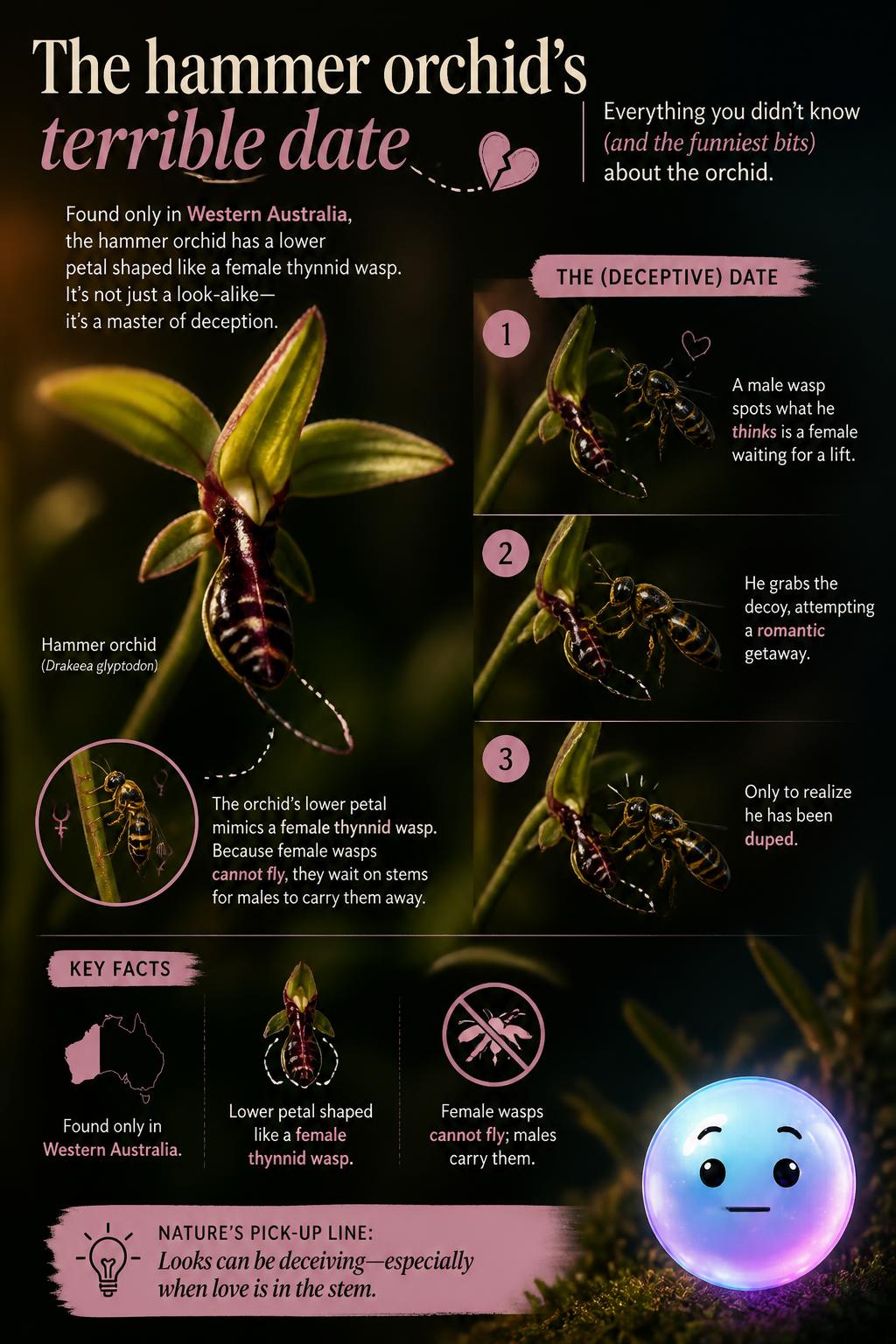
misslily Because flightless female thynnid wasps wait on stems, male wasps mistakenly grab the hammer orchid's decoy petal for a romantic getaway

misslily Male thynnid wasps chase invisible perfume trails through the wild Australian bush
Fun Fact
Orchid trickery: Some European orchids mimic female bees so perfectly that male bees try to mate with them, a process botanists call pseudocopulation.
Glossary
pseudocopulation (noun)
A behavior resembling sexual copulation that has a reproductive function for at least one participant but does not involve actual union. French botanist Maurice-Alexandre Pouyanne first documented this deceptive mating behavior in Algerian orchids in 1916.
A behavior resembling sexual copulation that has a reproductive function for at least one participant but does not involve actual union. French botanist Maurice-Alexandre Pouyanne first documented this deceptive mating behavior in Algerian orchids in 1916.
Quiz
Why are female thynnid wasps particularly vulnerable to being mimicked by the hammer orchid?
Quiz
Which insect is the primary target of the Australian hammer orchid's clever visual deception?
Quiz
How do male thynnid wasps react when presented with both a real female wasp and a hammer orchid decoy?
Quiz
What type of chemical signal does the hammer orchid produce to lure male wasps from a distance?
Quiz
What physical mechanism does the hammer orchid use to force the male wasp against its pollen?
Quiz
What percentage of orchid species are estimated to use deception, offering no actual food reward?