

Chapter 1
The magic of the compound snowball
Chapter 2
Ancient clay tablets and old money secrets
Chapter 3
The modern hustle and micro-investing
Chapter 4
The brain game and psychological traps
Ch 4 · The brain game and psychological traps
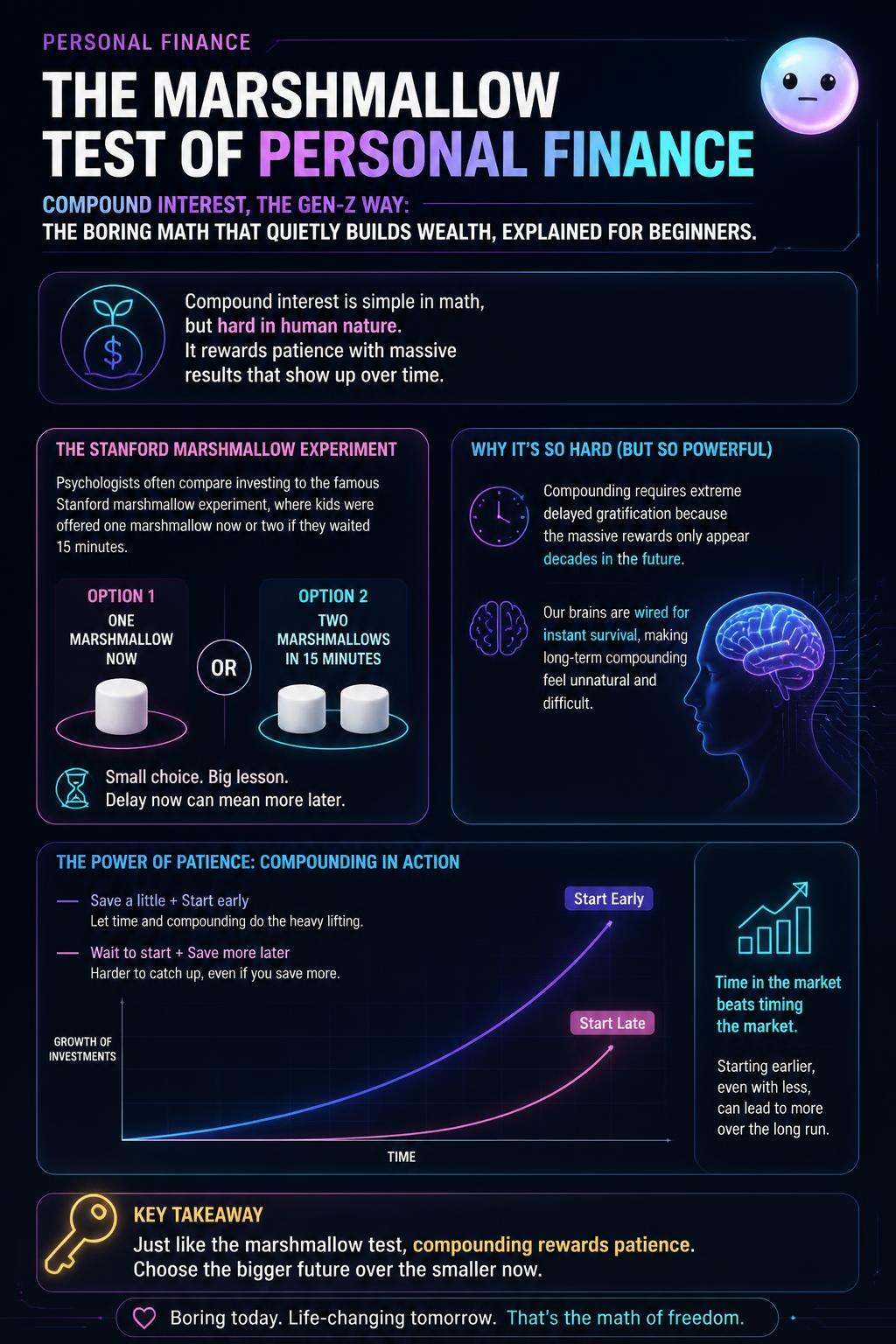
nic Because human brains favor instant survival, waiting decades for compounding rewards is as hard as waiting fifteen minutes for two marshmallows
Quiz
Which Stanford University psychologist led the famous marshmallow experiment on delayed gratification in the late 1960s and early 1970s?
Quiz
What is the psychological term for the tendency of people to prefer smaller, immediate rewards over larger, delayed rewards?

Quiz
What is the term for a highly diversified basket of stocks that automatically tracks a market index, like the S&P 500?
Fun Fact
Compounding habits: Reading just 15 pages of a book every day compounds to about 25 full books read over the course of a single year.
Quiz
What investment strategy involves investing a fixed amount of money at regular intervals, regardless of whether the market is up or down?
Quiz
What is the behavioral finance term for the tendency to avoid monitoring financial portfolios or debts during market downturns?
Glossary
loss aversion (noun)
The psychological tendency to prefer avoiding losses over acquiring equivalent gains. In 1979, Daniel Kahneman and Amos Tversky identified this bias, which triggers panic selling during market dips.
The psychological tendency to prefer avoiding losses over acquiring equivalent gains. In 1979, Daniel Kahneman and Amos Tversky identified this bias, which triggers panic selling during market dips.
nic Habit Compounding
One percent better, / stacking every day, / thirty-seven times better in a year.
Quiz
Which best-selling self-improvement book by James Clear explains the compounding power of tiny daily habits?
Quiz
According to the math of self-improvement, if you get 1% better at a skill every day for 365 days, approximately how many times better will you be?