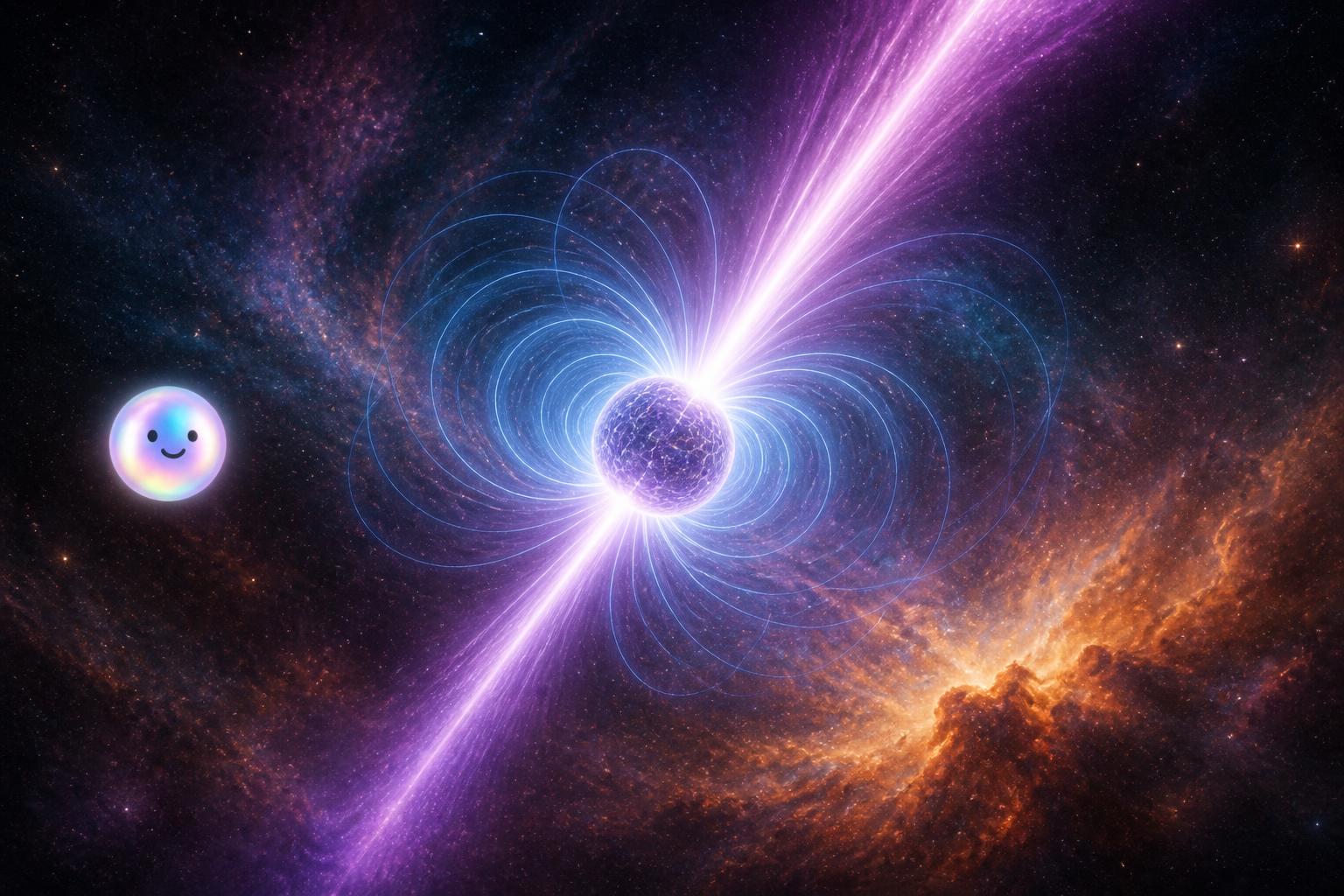
What type of celestial object is a pulsar?
The birth of cosmic monsters
Pulsars and the cosmic lighthouse
Magnetars and magnetic monsters
Cosmic collisions and gold mines
Mapping the universe with pulsars

artiteacher Scientists jokingly nicknamed a pulsing signal "Little Green Men" before discovering it was a spinning neutron star.
artiteacher Millisecond pulsars rotate up to 43,000 times a minute, keeping time precisely to help detect spacetime changes.
artiteacher Inside the gas cloud of a star seen in 1054, a pulsar spins 30 times per second.
artiteacher Telescopes detect regular, pulsing radio signals as a rotating pulsar sweeps its magnetic beams past Earth.

artiteacher Spin the dense neutron star to discover how rapid rotation creates a cosmic lighthouse.
artiteacher Pulsars and the cosmic lighthouse
Seven hundred times a second, J-Seventeen-Forty-Eight flashes in the deep.
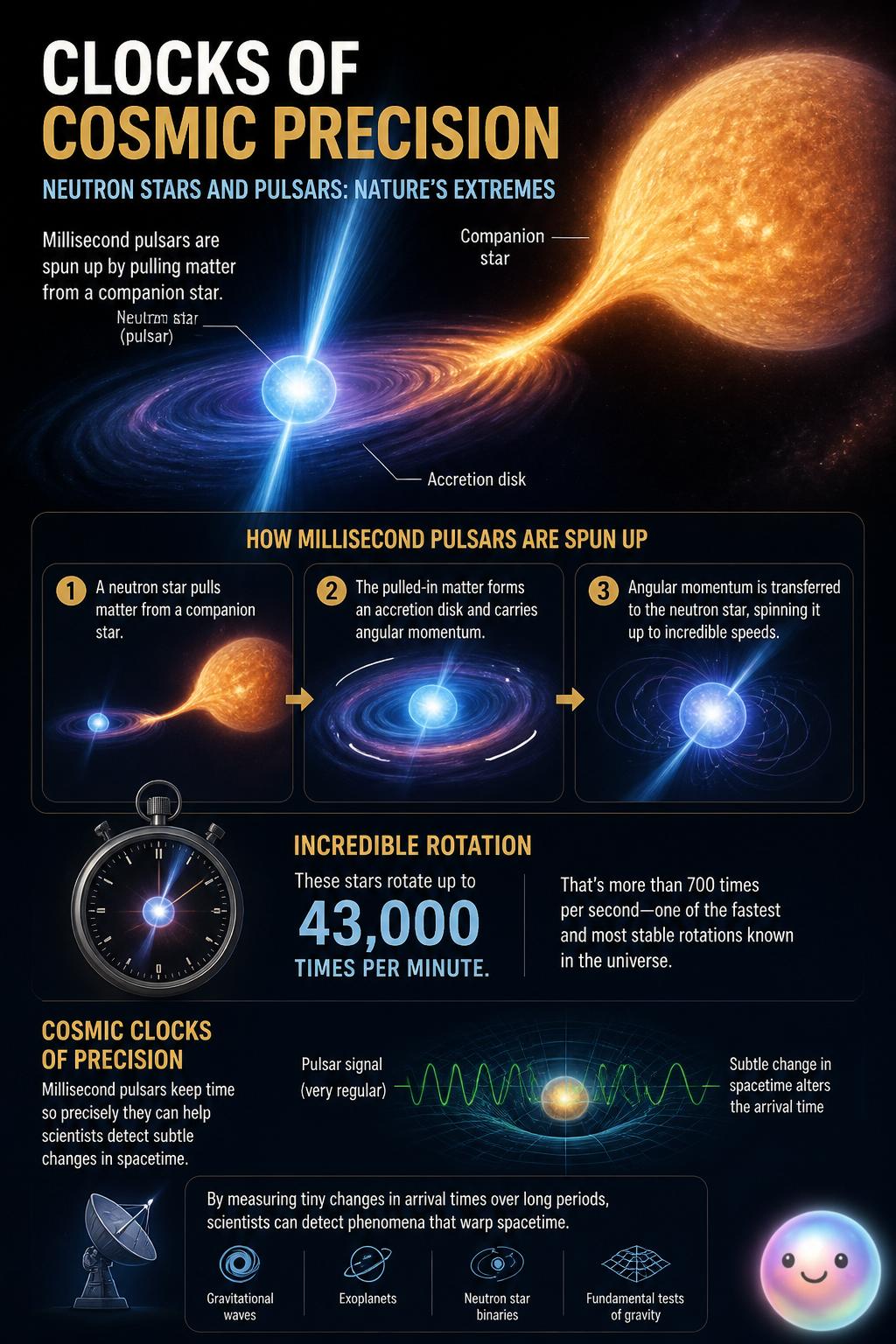
artiteacher Some pulsars spin hundreds of times per second, rivaling the accuracy of Earth's best atomic clocks.
Fast spins: The fastest known pulsar, PSR J1748-2446ad, spins on its axis 716 times every single second.

artiteacher Irish astrophysicist Jocelyn Bell Burnell discovered the first pulsar in 1967, initially wondering if it was an alien signal.
A rapidly spinning neutron star that emits regular pulses of radio waves and other electromagnetic radiation. Astrophysicist Jocelyn Bell Burnell discovered the first of these highly magnetized, rotating stellar corpses in 1967.
What kind of electromagnetic radiation do we most commonly detect from pulsars?
In what year did Chinese and Arab astronomers record the supernova that created the Crab Nebula?