
Why conifers look like party hats
Trees like spruces and firs in the Siberian taiga have a cone-shaped structure and downward-sloping, flexible branches. When heavy snow falls, the branches bend downward, letting the snow slide off safely. This prevents structural damage in regions that receive over 100 inches of snow annually.
The sleep of the giants
Natural antifreeze inside the trunk
Evergreen strategies across the globe


artiteacher Swipe heavy snow off the branches to discover how evergreens stay green all winter.
artiteacher Evergreen strategies across the globe
Sugar in our leaves (oh-oh-oh!) / Keeps the winter freeze away (yeah-yeah!)
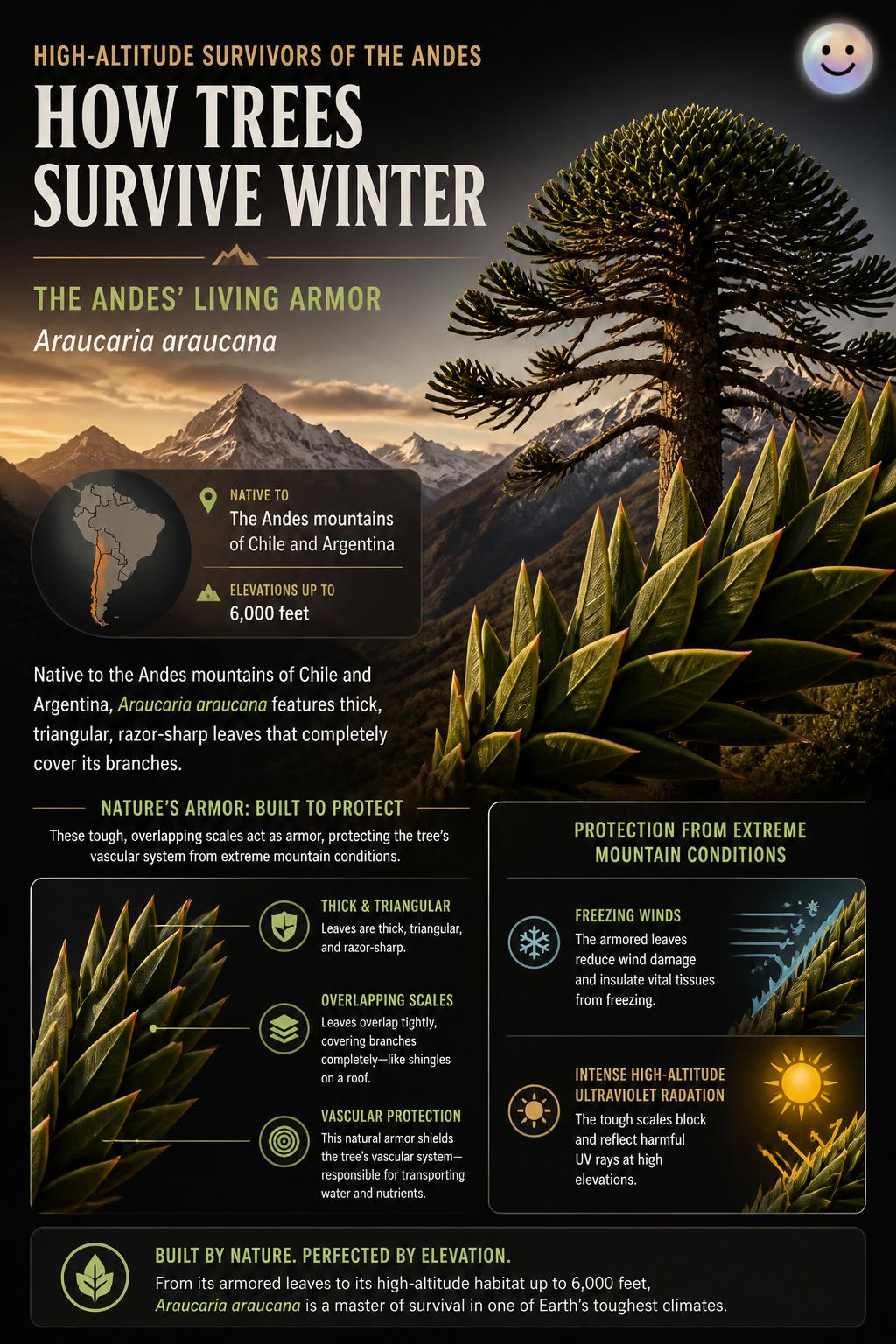
artiteacher The monkey puzzle tree of South America uses tough, scale-like leaves to survive freezing mountain winds.
Snow-shedding shapes: The conical shape of pine and fir trees acts like a steep roof, letting heavy snow slide off to prevent branches from breaking.

artiteacher The conical shape of boreal forest trees is an evolutionary design to shed heavy snow.
A plant that retains green leaves throughout the year. Boreal species survive freezing temperatures by using waxy leaf cuticles and concentrated sap as natural antifreeze.
How do flexible branches of spruces and firs respond to heavy snow accumulation?
What is the name of the thick, waxy outer layer that protects pine needles from drying out?
What is the main advantage of keeping leaves (needles) all winter for evergreen trees?
What percentage of the Earth's land surface is covered by boreal forests (taiga)?
In which mountain range does the ancient, scale-leafed monkey puzzle tree survive freezing winds?
Why do dark green needles of boreal forests absorb up to 90 percent of solar radiation?