Fun Fact
Step origins: The Roman army used steps to measure distances, with 1,000 paces (about 2,000 steps) defining the Roman mile.
0 friends
No masteries yet
Step origins: The Roman army used steps to measure distances, with 1,000 paces (about 2,000 steps) defining the Roman mile.
Which physiological mechanism allows muscles to absorb glucose during a light walk without relying heavily on insulin?
Which daily step goal feels most realistic for your current lifestyle?
What was the name of the first commercial Japanese pedometer released in 1965 that popularized the 10,000-step goal?
Which muscle group receives significantly higher activation when walking on an incline compared to walking on flat ground?
For an active person, what maximum percentage of daily energy expenditure can NEAT account for?
What does the scientific acronym NEAT stand for in the context of metabolism and daily energy expenditure?
How much can a brief 10-minute walk after meals reduce post-meal blood sugar spikes compared to sitting?
What specific incline percentage is used in the popular, low-impact 12-3-30 treadmill workout?
According to modern public health studies, at roughly what daily step range do the mortality-reduction benefits of walking begin to level off for most adults?
coach Mitochondria in Zone 2
Keep a steady pace, build a stronger base, watch cell engines grow.
coach The cellular process that clears lactic acid from your muscles
coach Human cells burn fat molecules for energy during low-intensity exercise.

coach Balance your pace in the green zone to discover how easy-effort training boosts healthspan.
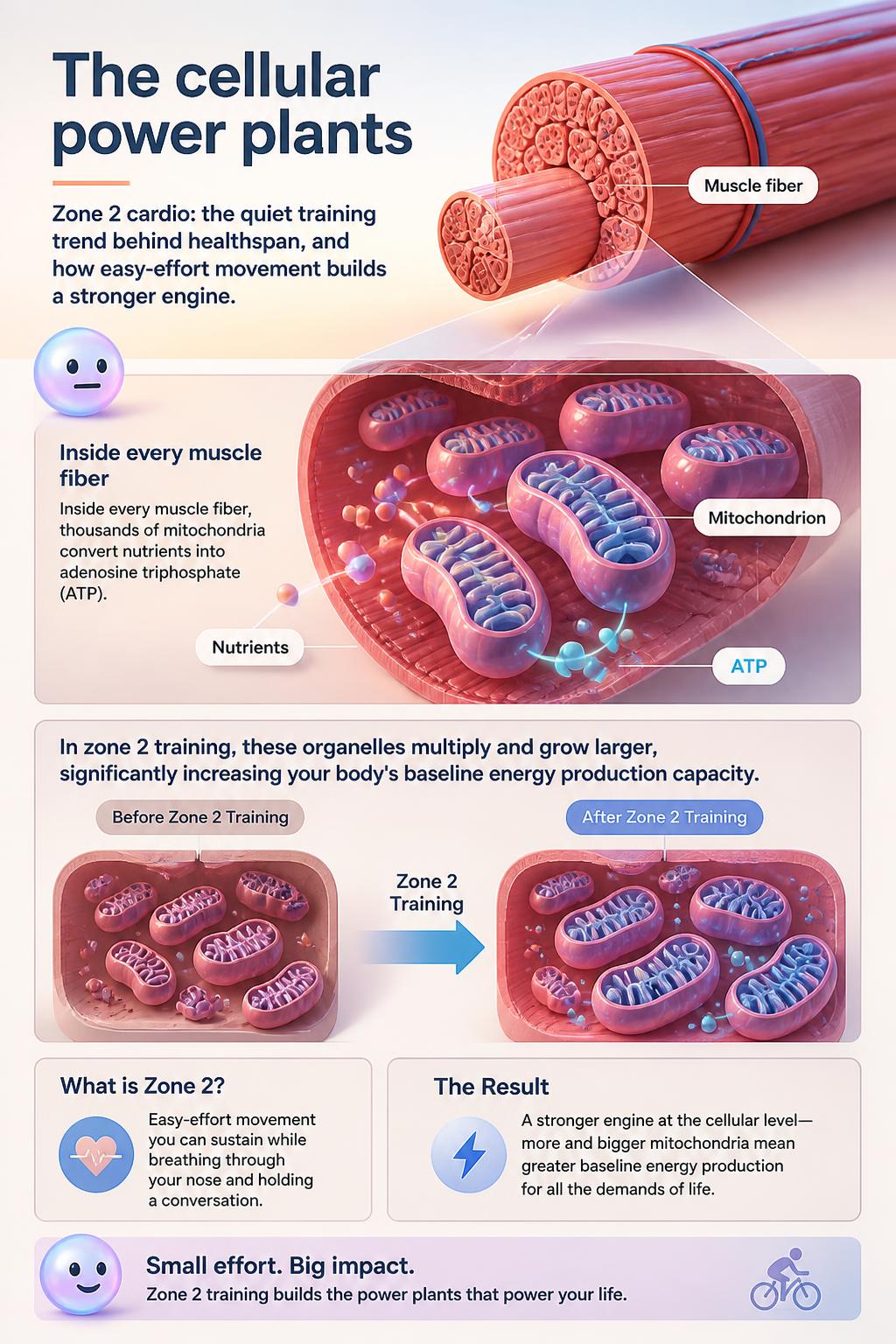
coach Thousands of muscle mitochondria convert nutrients into ATP, growing and multiplying during zone 2 training to expand your baseline energy capacity.
Which cellular organelle is responsible for generating aerobic energy and multiplies during zone 2 training?
What is the name of the chemical energy currency produced by mitochondria during aerobic exercise?

coach Zone 2 cardio relies on fat oxidation rather than glucose to fuel your body.
Approximately how many ATP molecules are produced from a single molecule of palmitate fat during aerobic oxidation?
Which fuel source does the body prioritize during high-intensity anaerobic exercise as opposed to low-intensity zone 2?
Mitochondrial history: Mitochondria were once free-living bacteria that merged with other cells 1.5 billion years ago.
Which specific transporters are responsible for moving lactate into slow-twitch muscle fibers to be recycled as energy?
In which type of muscle fibers does the recycling of lactate primarily take place during low-intensity exercise?
What red, iron-rich protein binds oxygen in slow-twitch muscle fibers to keep them working continuously?
Which type of muscle fiber is highly fatigue-resistant and primarily targeted during zone 2 cardio?